Crucial Comix logo on a green background
$0.00 0

Cart

No products in the cart.

Published March 31, 2026

A Scanner Constantly

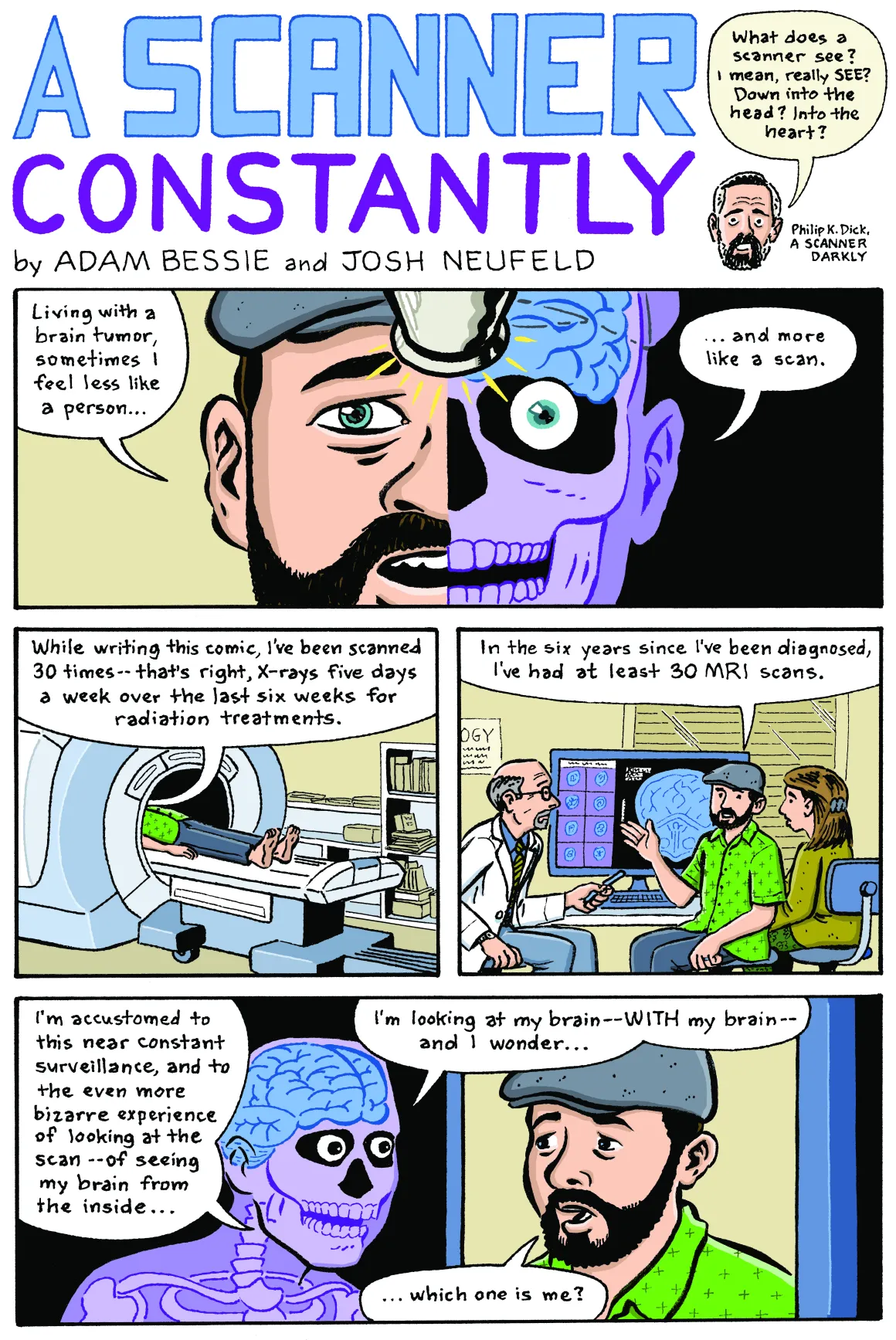
Living with a brain tumor, sometimes I feel less like a person, and more like a scan.
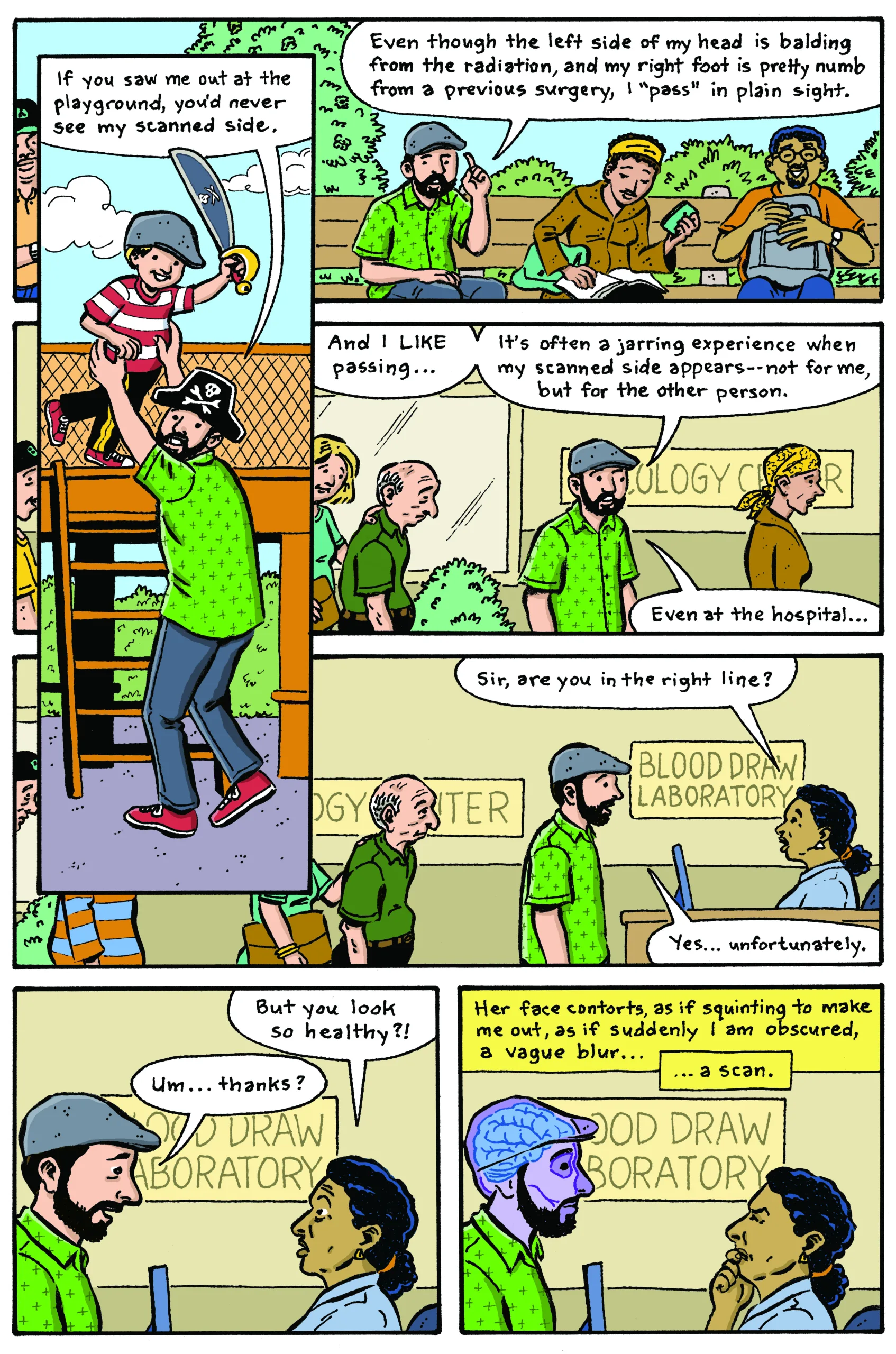
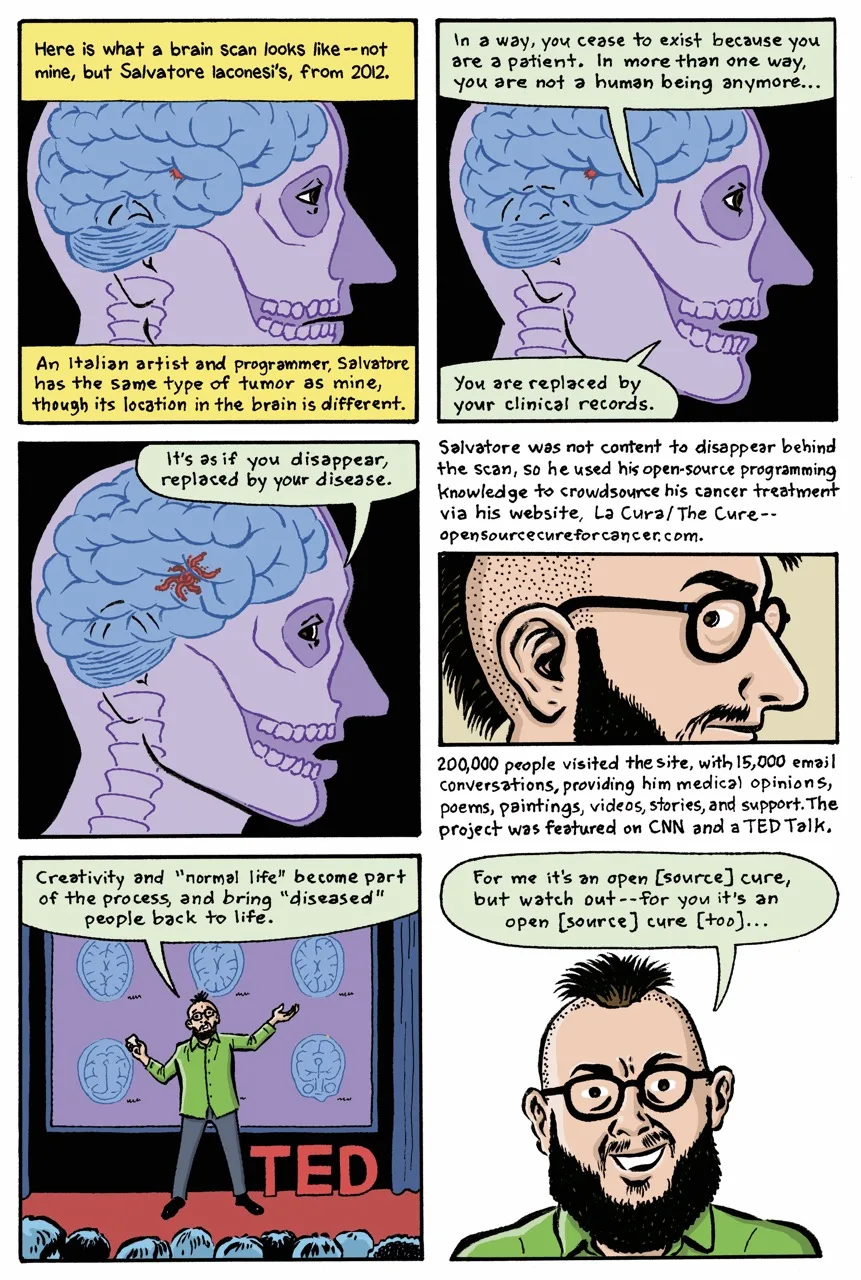
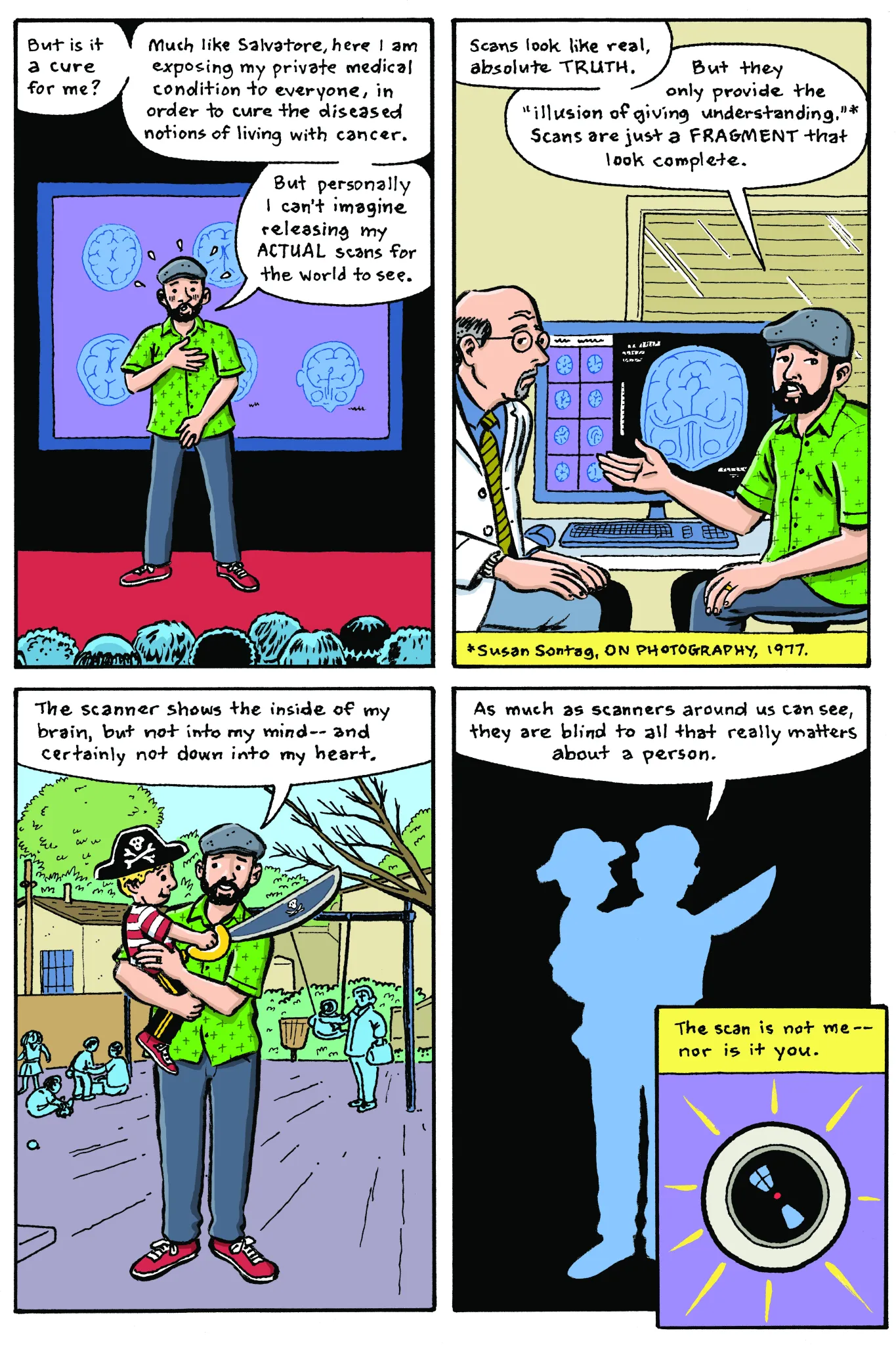
A Scanner Constantly by Adam Bessie and Josh Neufeld. Quote from Philip K. Dick, A Scanner Darkly: “What does a scanner see? I mean, really see? Down into the head? Into the heart? Panel 1: Adam, a man with light skin, a dark beard wearing a pageboy cap. Half of his face is visible, the other half of his face is translucent, showing the skull and brain underneath his skin: “Living with a brain tumor, sometimes I feel less like a person, and more like a scan.” Panel 2: Adam, laying down with his head within a FMRI scanner: “While writing this comic, I’ve been scanned 30 times—that’s right, X-rays five days a week over the last six weeks for radiation treatments.” Panel 3: Adam, with a doctor looking at brain scan results: “In the six years since I’ve been diagnosed, I’ve had at least 30 MRI scans.” Panel 4: Adam’s scanned doppelganger, with translucent skin through which his skeleton and brain are visible: “I’m accustomed to this near constant surveillance, and to the even more bizarre experience of looking at the scan—of seeing my brain from the inside. I’m looking at my brain—with my brain—and I wonder…” Adam: “Which one is me?”Panel 1: Adam plays with his son. His son holds a pirate sword, Adam wears a pirate hat. Adam: “If you saw me out at the playground, you'd never see my scanned side.” Panel 2: Adam sits at a park bench with other parents. Adam: “Even though the left side of my head is balding from the radiation, and my right foot is pretty numb from a previous surgery, I “pass” in plain sight.” Panel 3: Adam stands in line at the blood draw laboratory with other patients. Adam: “And I like passing. It’s often a jarring experience when my scanned side appears—not for me, but for the other person. Even at the hospital…” Panel 4: Hospital clerk: “Sir, are you in the right line?” Adam: “Yes, unfortunately.” Panel 5: Hospital clerk is surprised: “But you look so healthy?!” Adam: “Um… thanks?” Panel 6: Caption: “Her face contorts, as if squinting to make me out, as if suddenly I am obscured, a vague blur, a scan.” Adams skin turns translucent, his skull and brain visible beneath his obscured face.Panel 1: A brain scan, with a small red tumor tucked into the center of the brain’s wrinkles. Caption: “Here is what a brain scan looks like—not mine, but Salvatore Ianconesi’s, from 2012. An Italian artist and programmer, Salvatore has the same type of tumor as mine, though its location in the brain is different.” Panel 2: The scanned person speaks, their expression neutral and their face anonymized by their translucent skin: “In a way, you cease to exist because you are a patient. In more than one way, you are not a human being anymore. You are replaced by your clinical records.” Panel 3: Scanned person: “It’s as if you disappear, replaced by your disease.” Panel 4: Salvatore, in the same position as the scanned person with a skeptical, alert expression. He has a beard and mohawk, and wears thick-framed glasses. Caption: “Salvatore was not content to disappear behind the scan, so he used his open-source programming knowledge to crowdsounce his cancer treatment via his website, La Cura/The Cure—opensourcecureforcancer.com. 200,000 people visited the site, with 15,000 email conversations, providing him with medical opinions, poems, paintings, videos, stories, and support. The project was featured on CNN and a TED Talk. Panel 5: Salvatore stands in front of several scans of his brain, presenting his TED Talk: “Creativity and “normal life” become part of the process, and bring “diseased” people back to life.” Panel 6: Salvatore looks determined: “For me, it’s an open source cure, but watch out—for you it’s an open source cure too.”Panel 1: Adam stands where Salvatore was, presenting the TED Talk. He looks embarrassed. Adam: “But is it a cure for me? Much like Salvatore, here I am exposing my private medical condition to everyone, in order to cure the diseased notions of living with cancer. But personally I can’t imagine releasing my actual scans for the world to see.” Panel 2: Adam sits with his doctor in front of a computer displaying brain scans. Adam: “Scans look like real, absolute truth. But they only provide the “illusion of giving understanding” (Susan Sontag, On Photography, 1977). Scans are just a fragment that look complete.” Panel 3: Adam holds his son at the playground. Adam: “The scanner shows the inside of my brain, but not into my mind—and certainly not down into my heart.” Panel 4: A silhouette of Adam holding his son. Neither are visible beyond their outline, the playground has been replaced with a field of black. Adam: “As much as scanners around us can see, they are blind to all that really matters about a person.” Panel 5: The reflective lens of a scanner. Caption: “The scan is not me—nor is it you.”

This comic was originally published by Pacific Standard magazine.

More Comics

Join our newsletter

Get Crucial Comix in your inbox!
© 2026 Crucial Comix