

Crucial Comix logo on a green background
$0.00 0

Cart

No products in the cart.

Published May 1, 2026

The Third Bronze

The mystery of a missing Italian sculpture makes me think about the unknowns of my own family history.
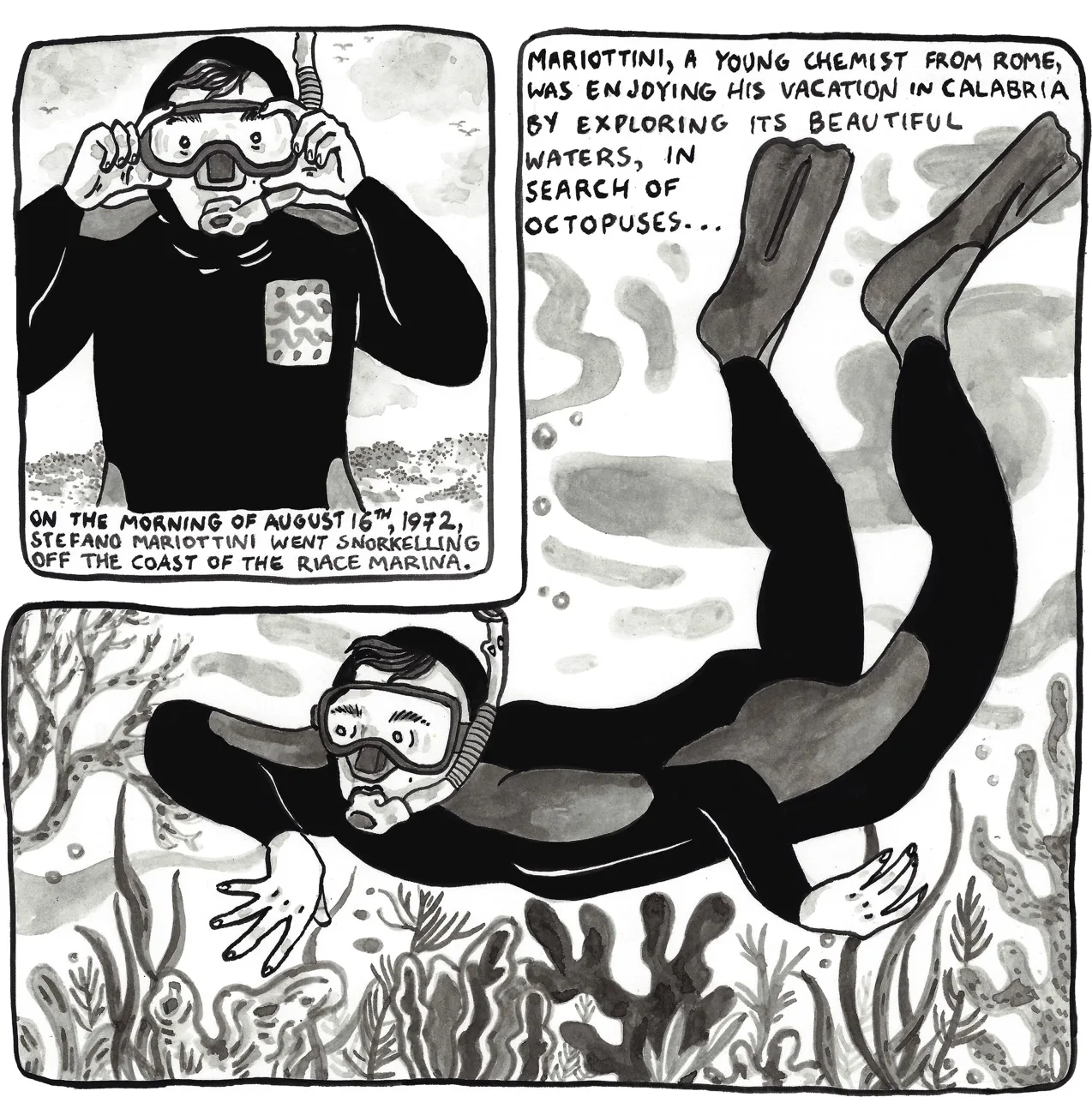
Panel 1 shows Stefano Mariottini, a light-skinned man in his mid-twenties wearing a wetsuit and snorkel. He adjusts a pair of goggles over his eyes. The caption reads “On the morning of August 16th, 1972, Stefano Mariottini went snorkeling off the coast of the Riace Marina.” Panel 2 shows Mariottini swimming underwater, the position of his body suggesting he’s just dived down. Various aquatic plants rise up from the bottom of the panel. The caption reads “Mariottini, a young chemist from Rome, was enjoying his vacation in Calabria by exploring the beautiful waters of the Southernmost tip of Italy, in search of octopuses.”
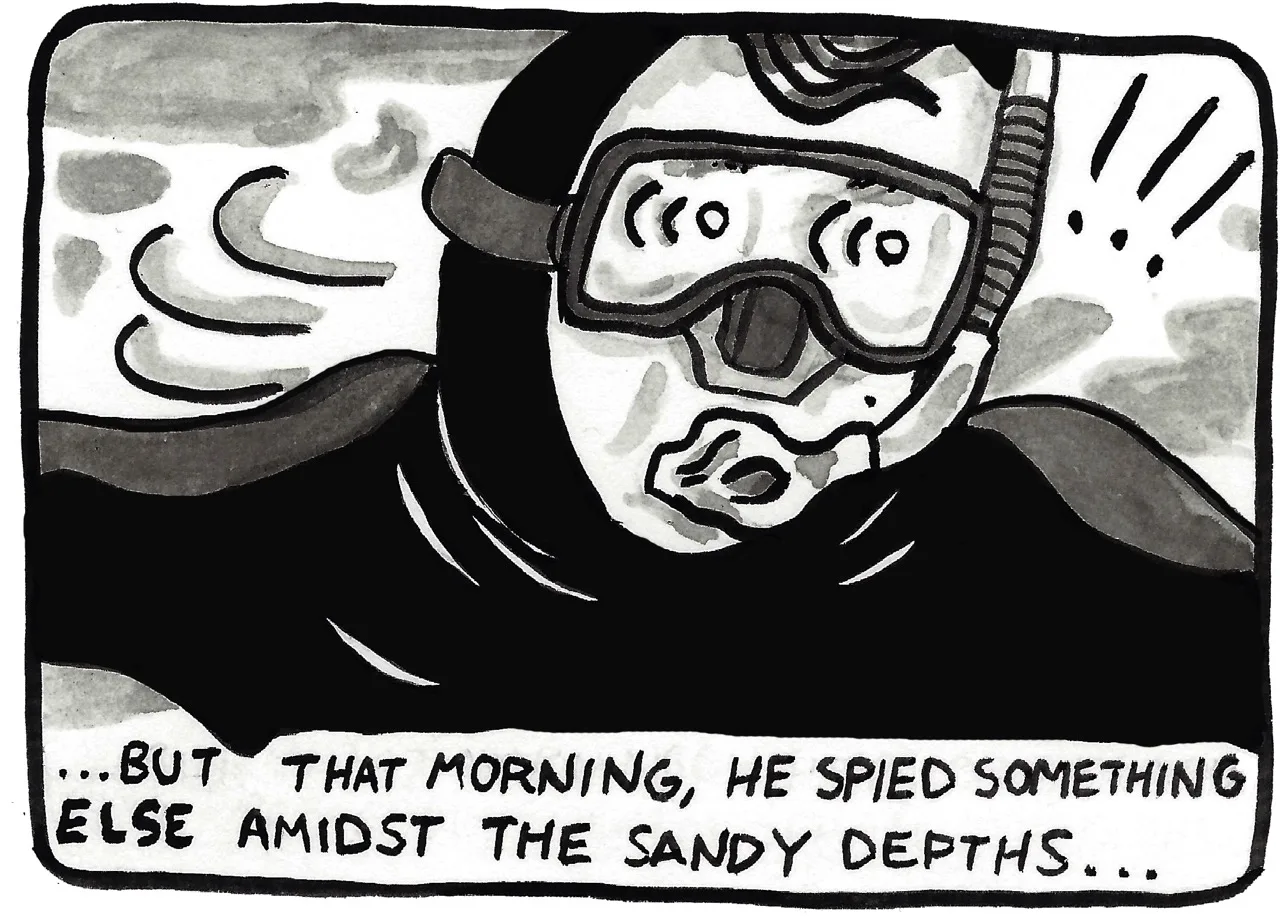
Panel 3 is a closeup of Mariottini’s head swerving quickly to look to the right. The caption reads “...But that morning, he spied something else amidst the sandy depths…”
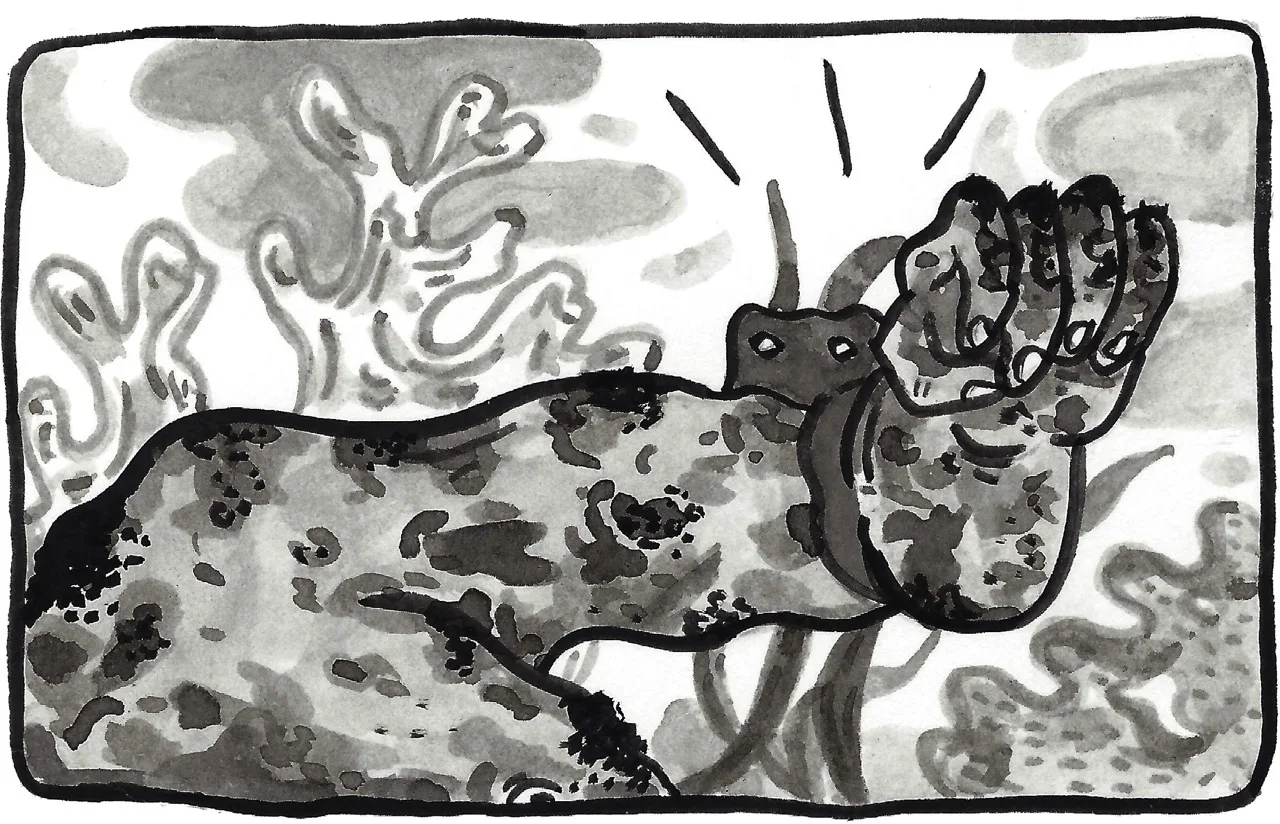
Panel 4 is a closeup of an arm rising from among the aquatic vegetation. The hand forms a fist, as if it were once gripping something, and there is a band around the forearm. The arm is covered in encrustations and dark patches.
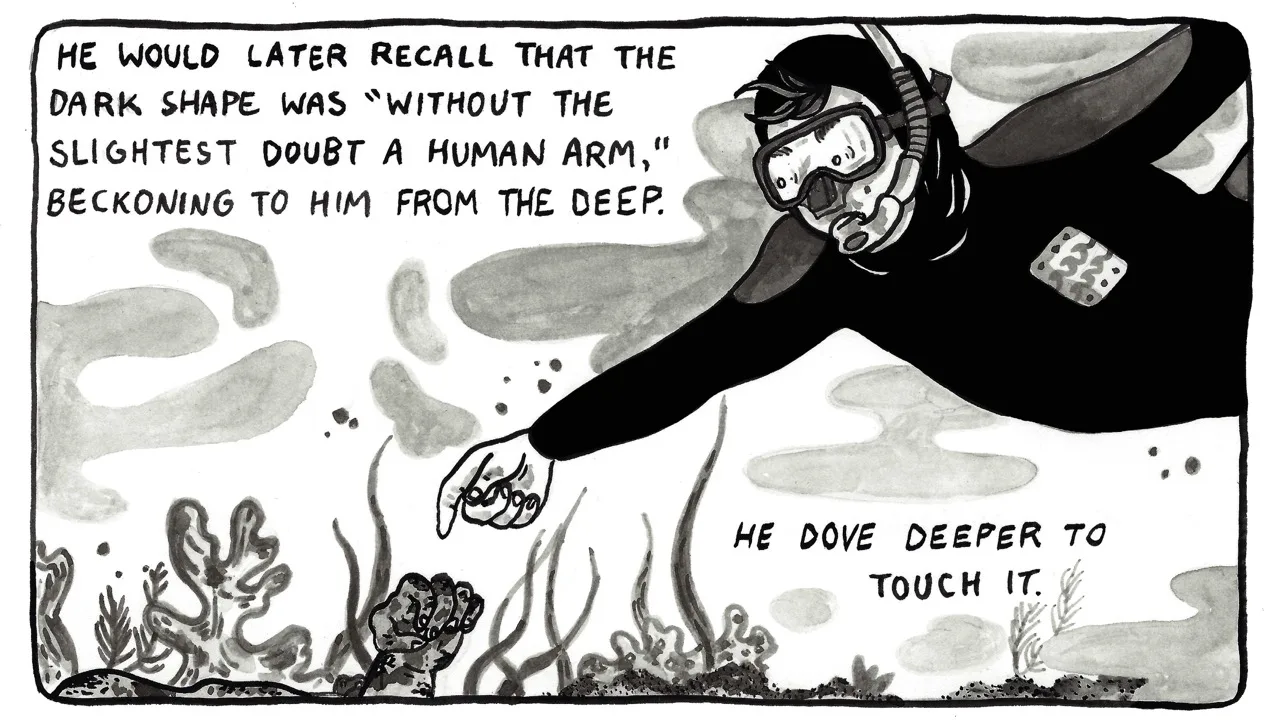
Panel 5 Mariottini dives with one hand reaching down below him, his forefinger about to touch the hand which rises from the bottom of the panel. The text reads “He would later recall that the dark shape was “without the slightest doubt a human arm,” beckoning to him from the deep. He dove deeper to touch it.”
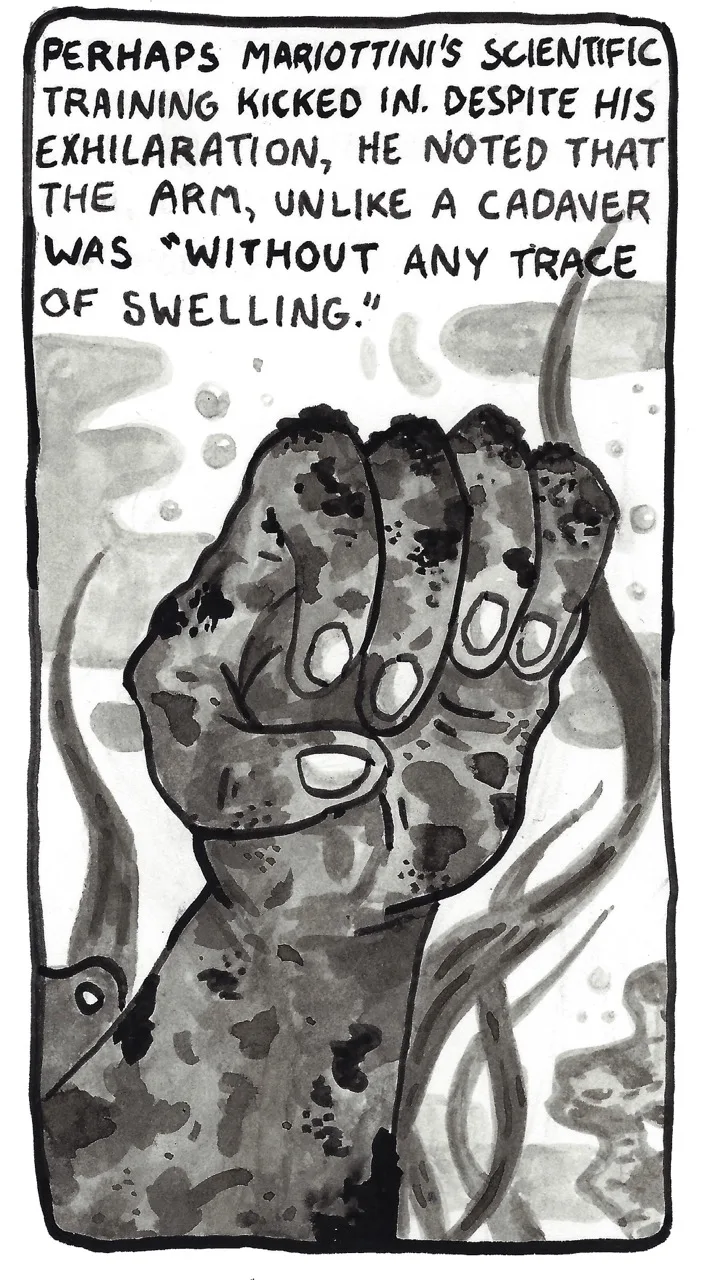
Panel 6 is a closeup of the hand, a few fronds of seaweed floating around it. The caption reads “Perhaps Mariottini’s scientific training kicked in. Despite his exhilaration, he noted that the arm, unlike a cadaver, was “without any trace of swelling.”
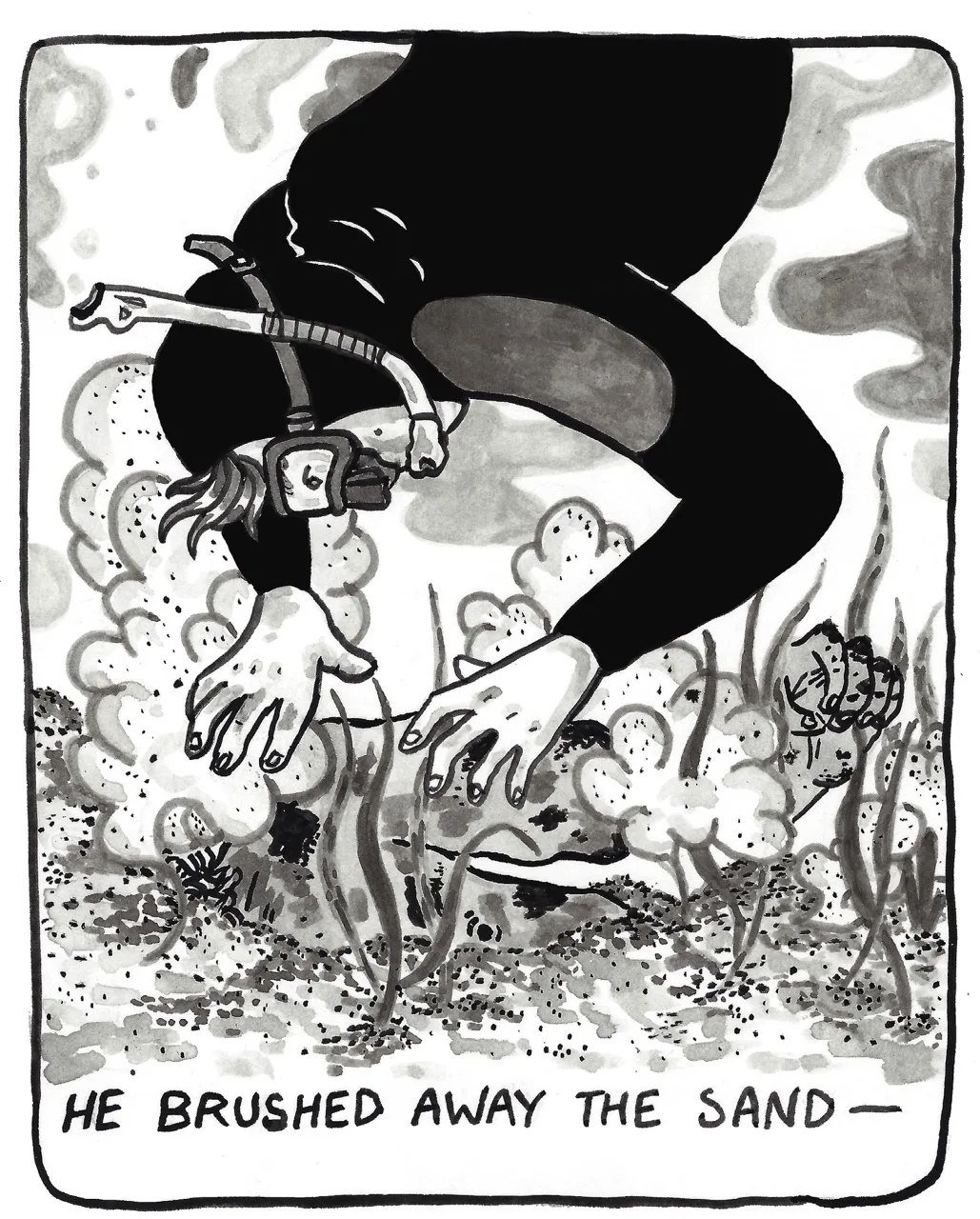
Panel 7 shows Mariottini diving from the top of the frame. He brushes sand off of the statue, plumes of sand rising in clouds and obscuring parts of it. The caption reads “He brushed the sand away — ”
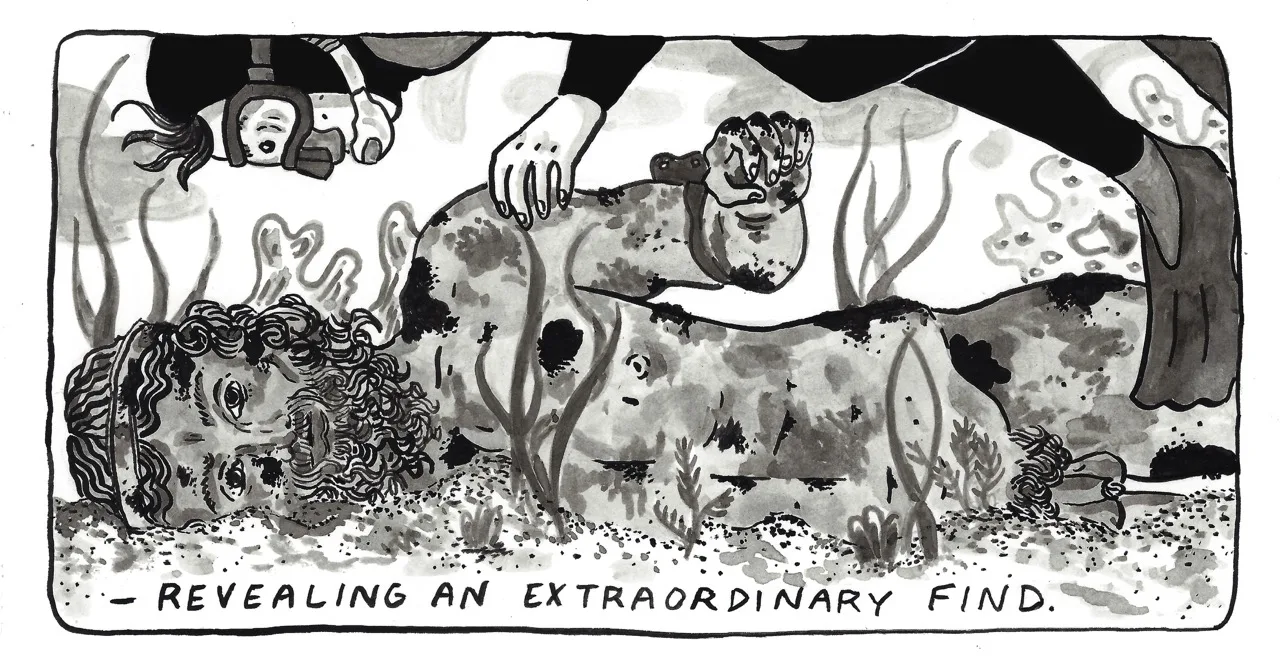
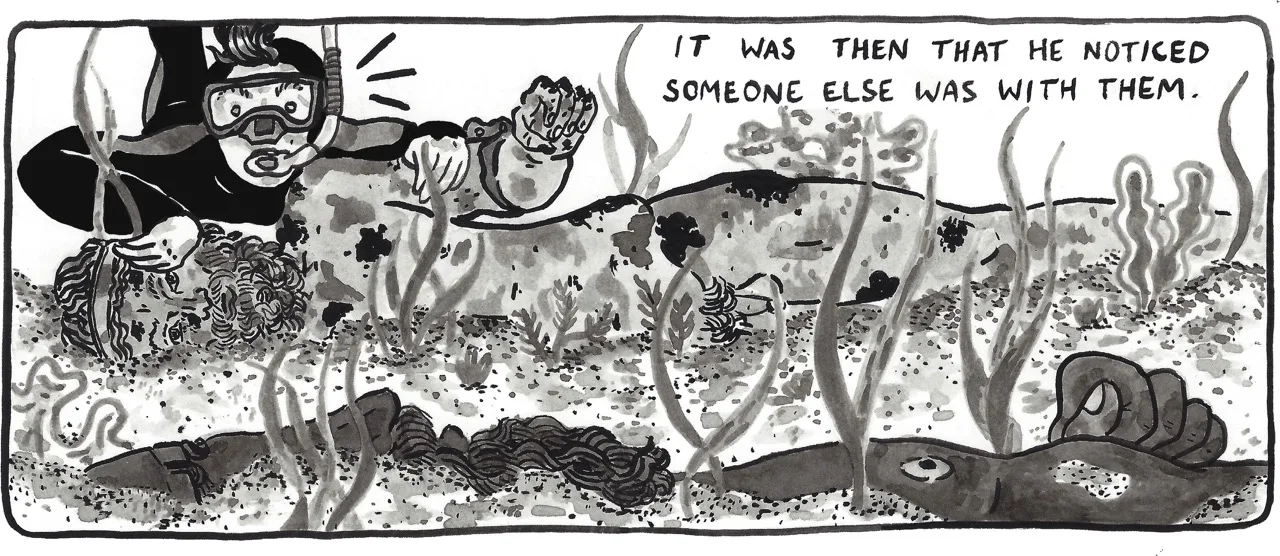
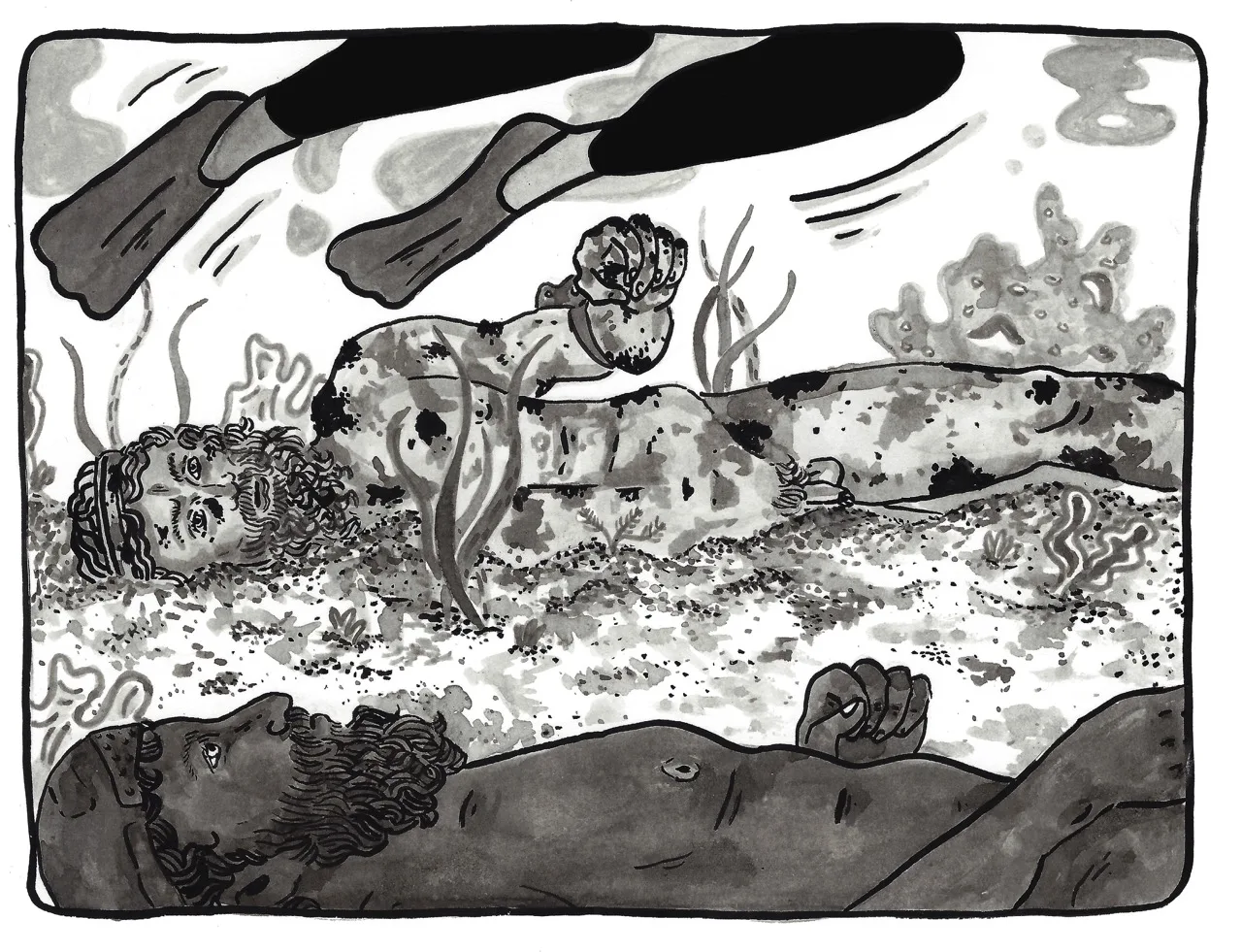
Panel 8 Mariottini floats along the top of the frame. His hand tentatively rests on the shoulder of the statue, now revealed to be lying on its side, and slightly larger than life. The statue has a long, curly beard and hair, is wearing a headband, but is otherwise nude. The caption reads “ — Revealing an extraordinary find.”Panel 9 We zoom out slightly, to see that there is another statue in the foreground. This statue lies on its back. We can see that it, too, is bearded, but parts of its face are obscured by sand. Mariottini, still with the first statue, is in the background, his eyes wide. The text reads “It was then that he noticed someone else was with them.”
Panel 10 We see Mariottini from behind, brushing the sand away from the second statue. The sand plumes up in clouds, through which we can see the bits of the second statue’s face.
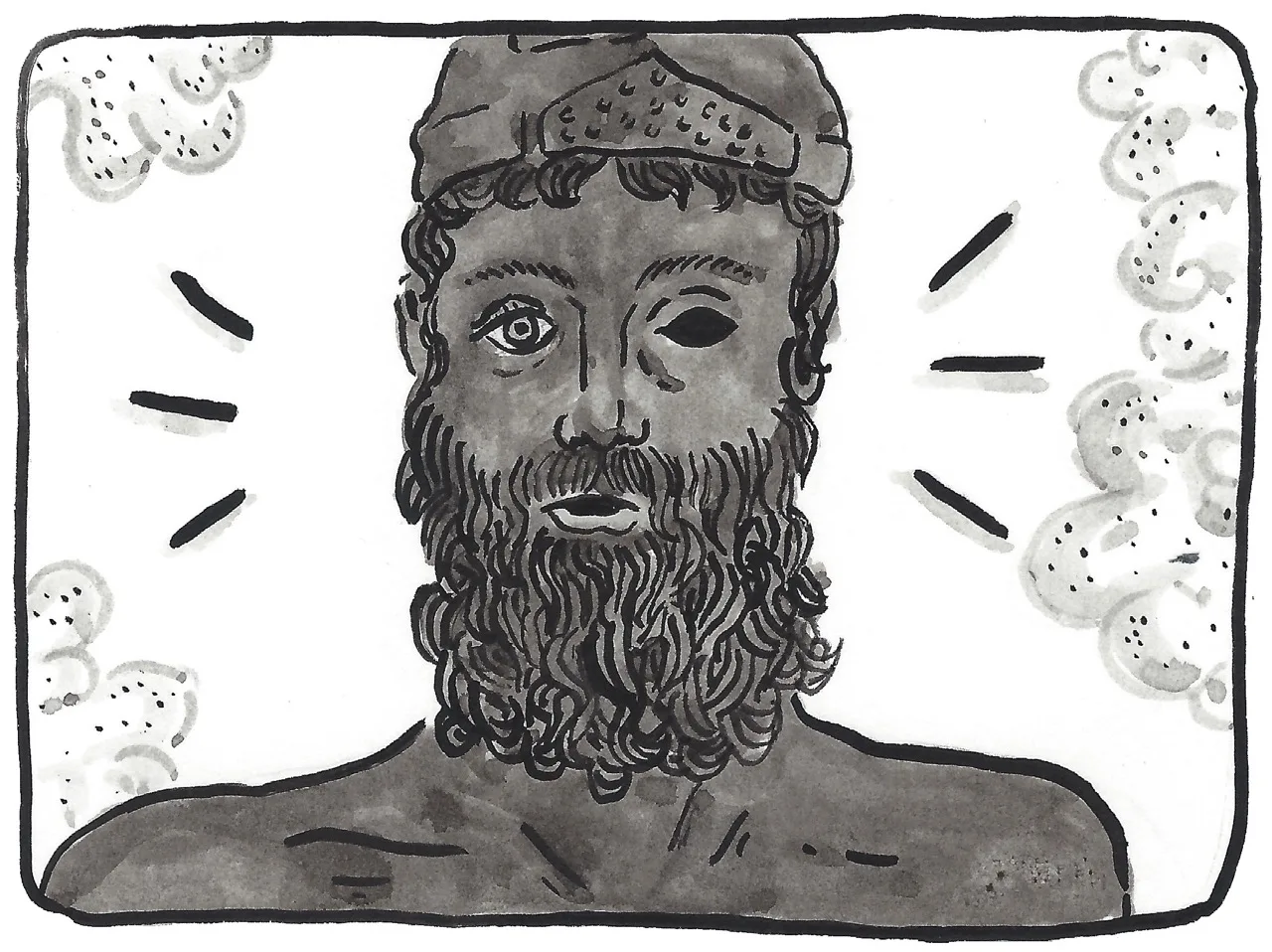
Panel 11 The clouds part, revealing the face of the second statue. His beard is straighter than the first, and his head shape suggests part of a helmet. His left eye is missing.
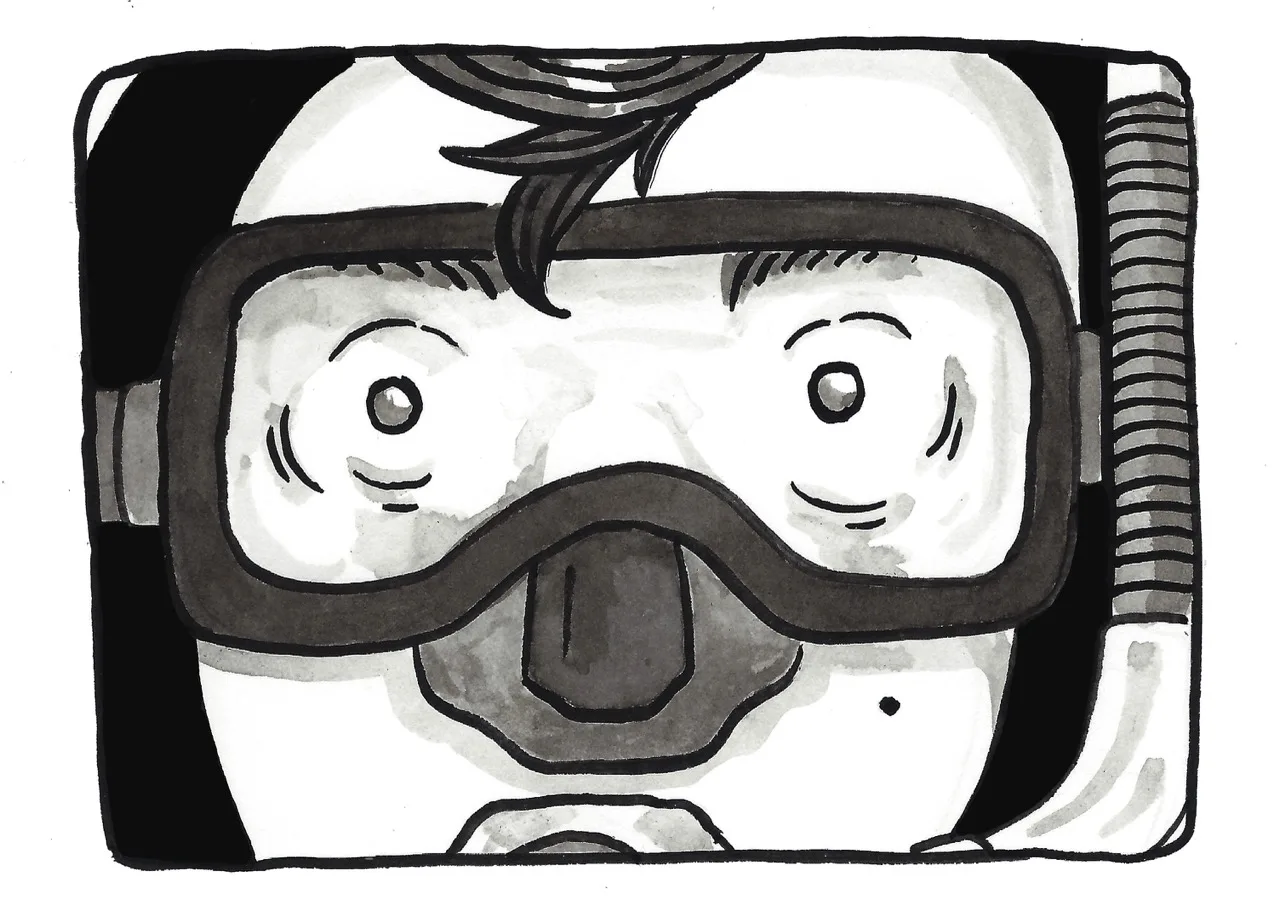
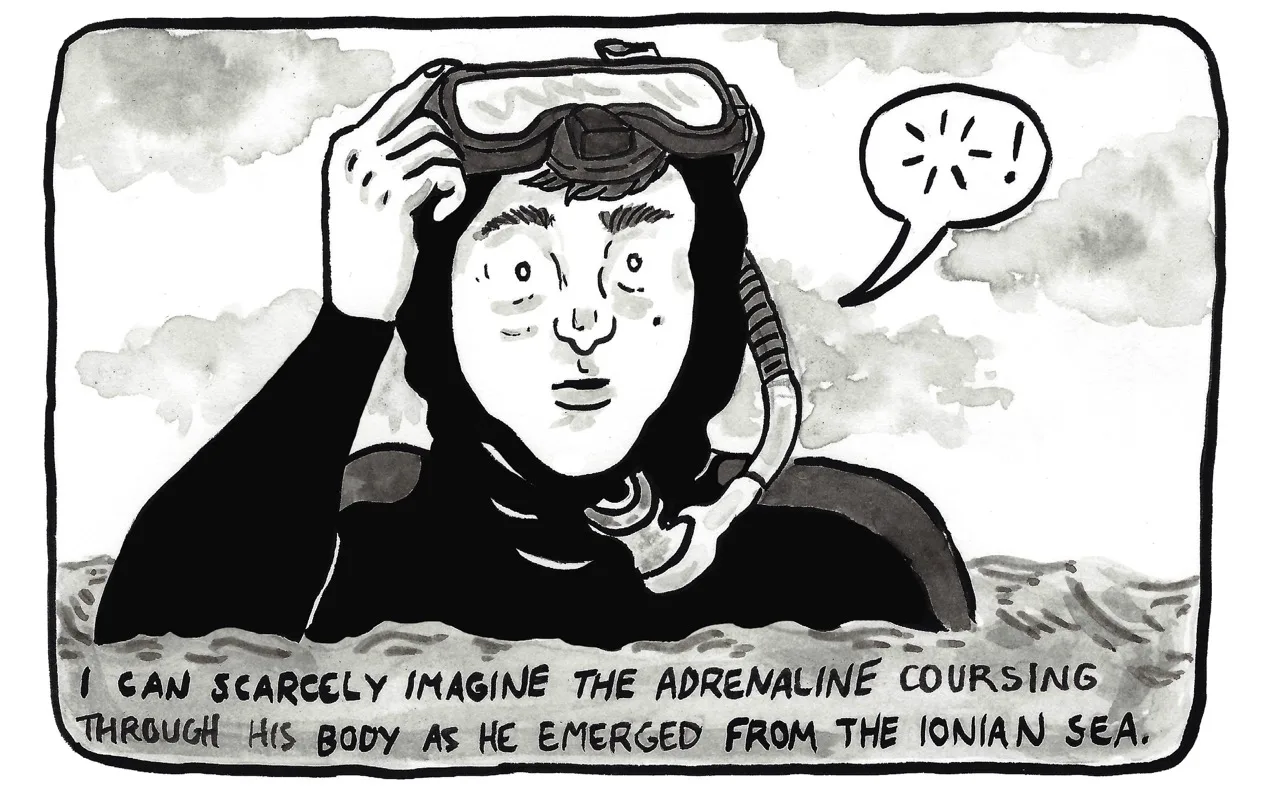
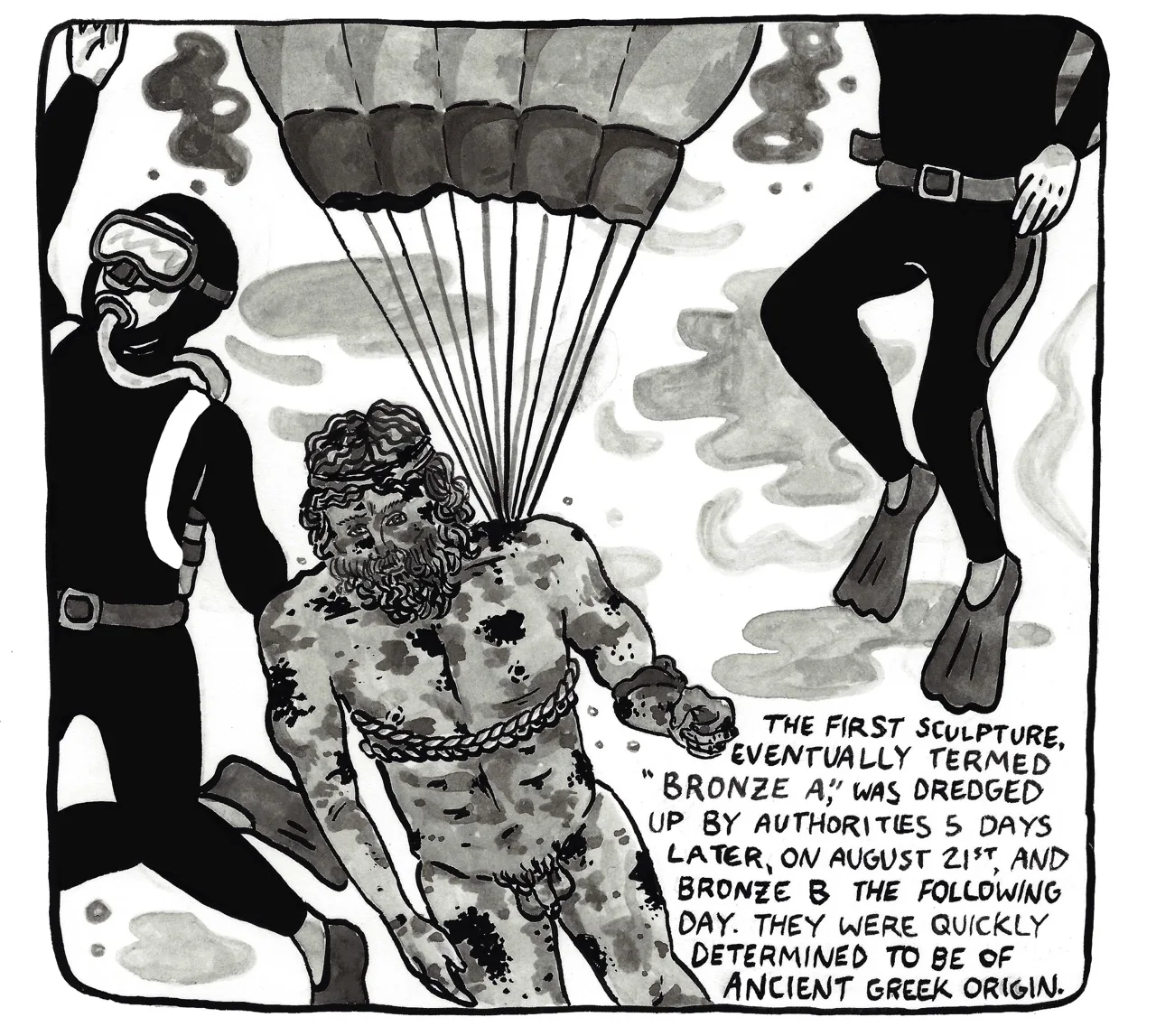
Panel 12 A hyper close-up of Mariottini’s face through his snorkelling mask. His eyes are wide with surprise.Panel 13 is a wide shot of both statues on the sea floor. Mariottini swims away into the top of the panel, only his legs and feet with his flippers visible.Panel 14 Mariottini emerges from the sea. The snorkel is out of his mouth and he pushes up his goggles with one hand. A speech bubble contains a small burst of lines, conveying a sharp exhale. The caption reads “I can scarcely imagine the adrenaline coursing through his body as he emerged from the Ionian Sea.”Panel 15 Two scuba divers swim upwards. One of them has a hand on the first statue, which is attached to an underwater lift bag which resembles a parachute. The caption reads “The first sculpture, eventually termed “Bronze A,” was dredged up by authorities 5 days later, on August 21st, and Bronze B the following day. They were quickly determined to be of Ancient Greek origin.”
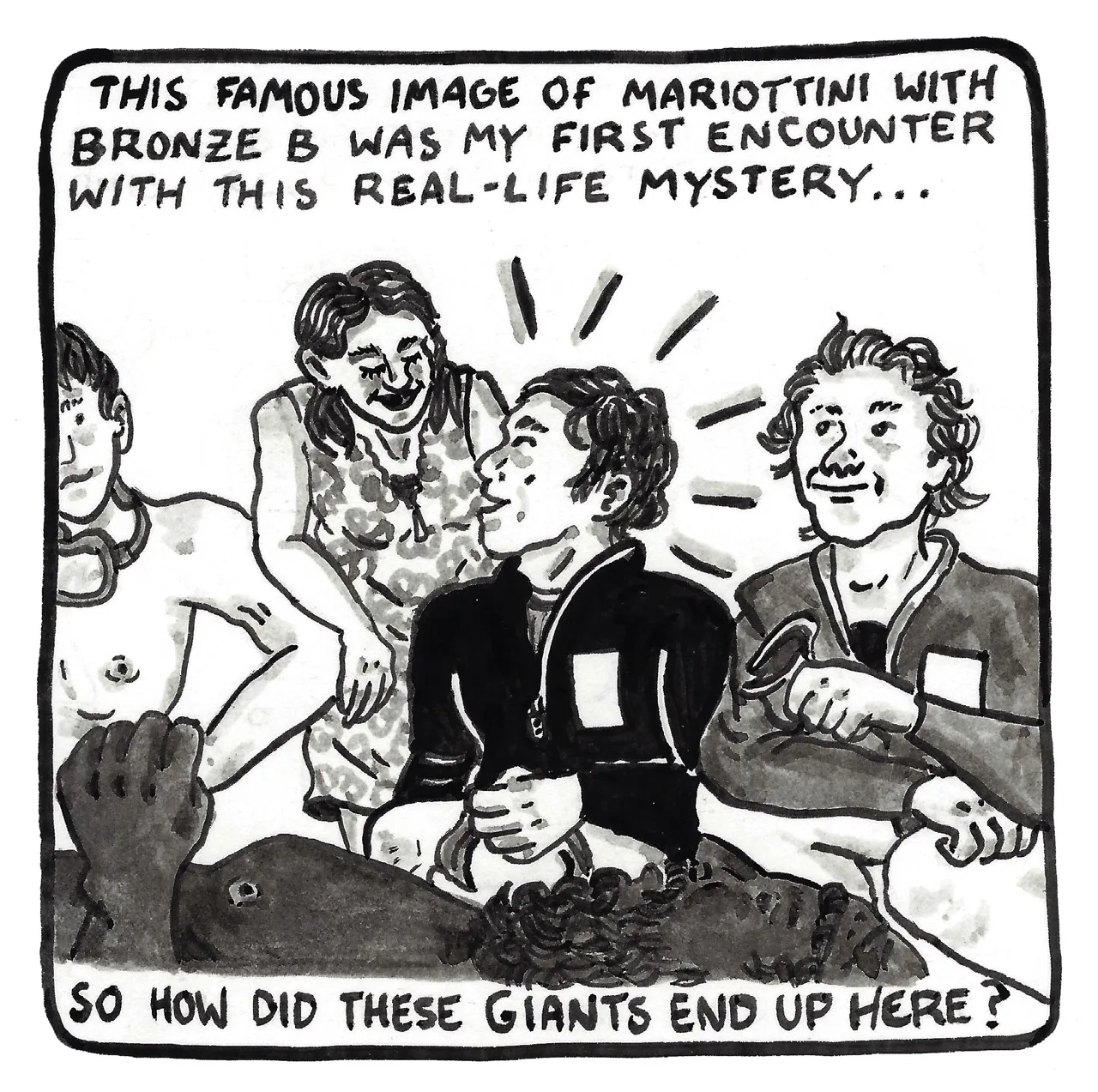
Panel 16 shows a group of people congregated over the dredged-up Bronze B, which lies on its back. Mariottini is at the centre, beaming. The text reads “This famous image of Mariottini with Bronze B was my first encounter with this real-life mystery…so how did these giants end up here?”
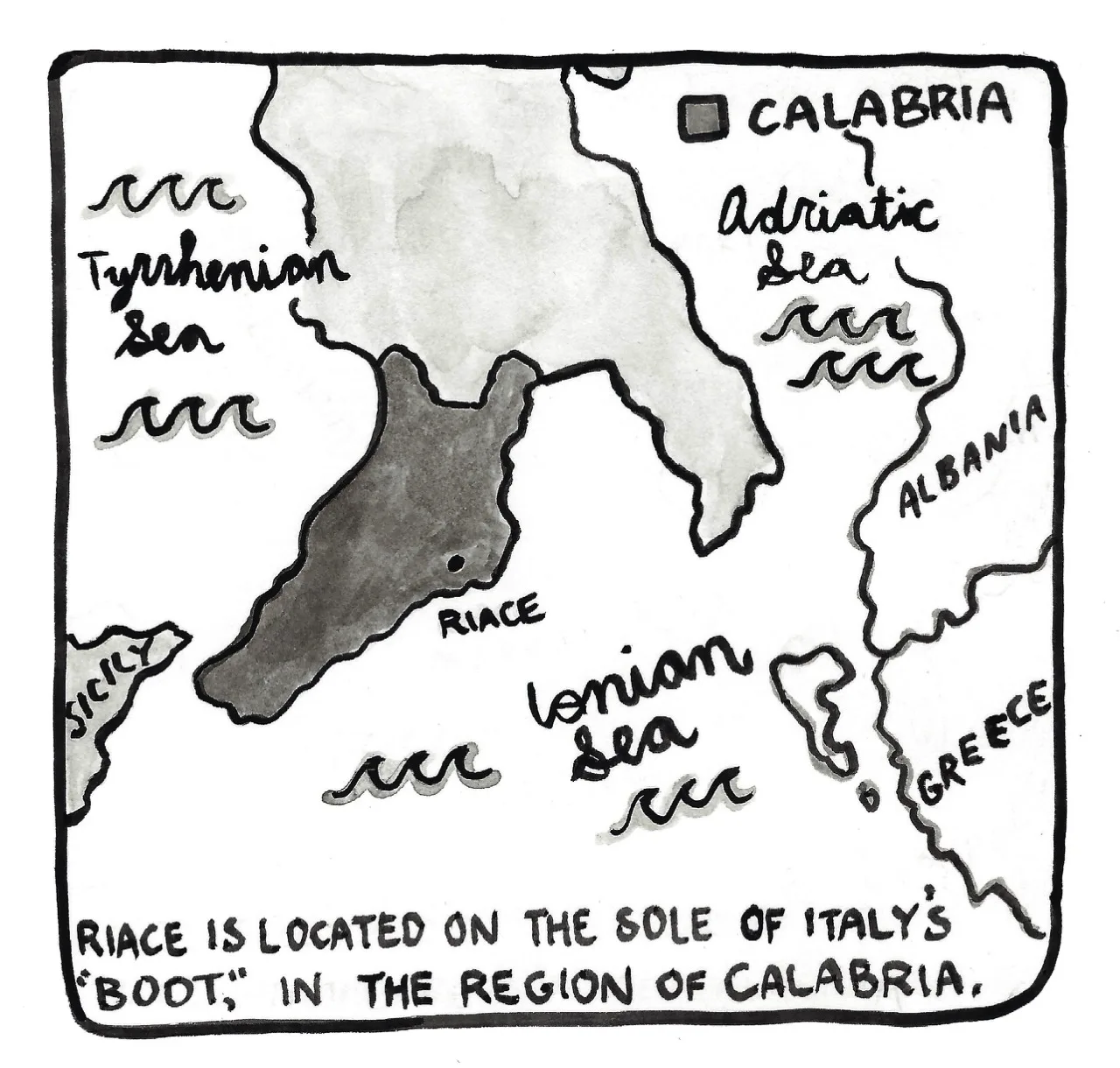
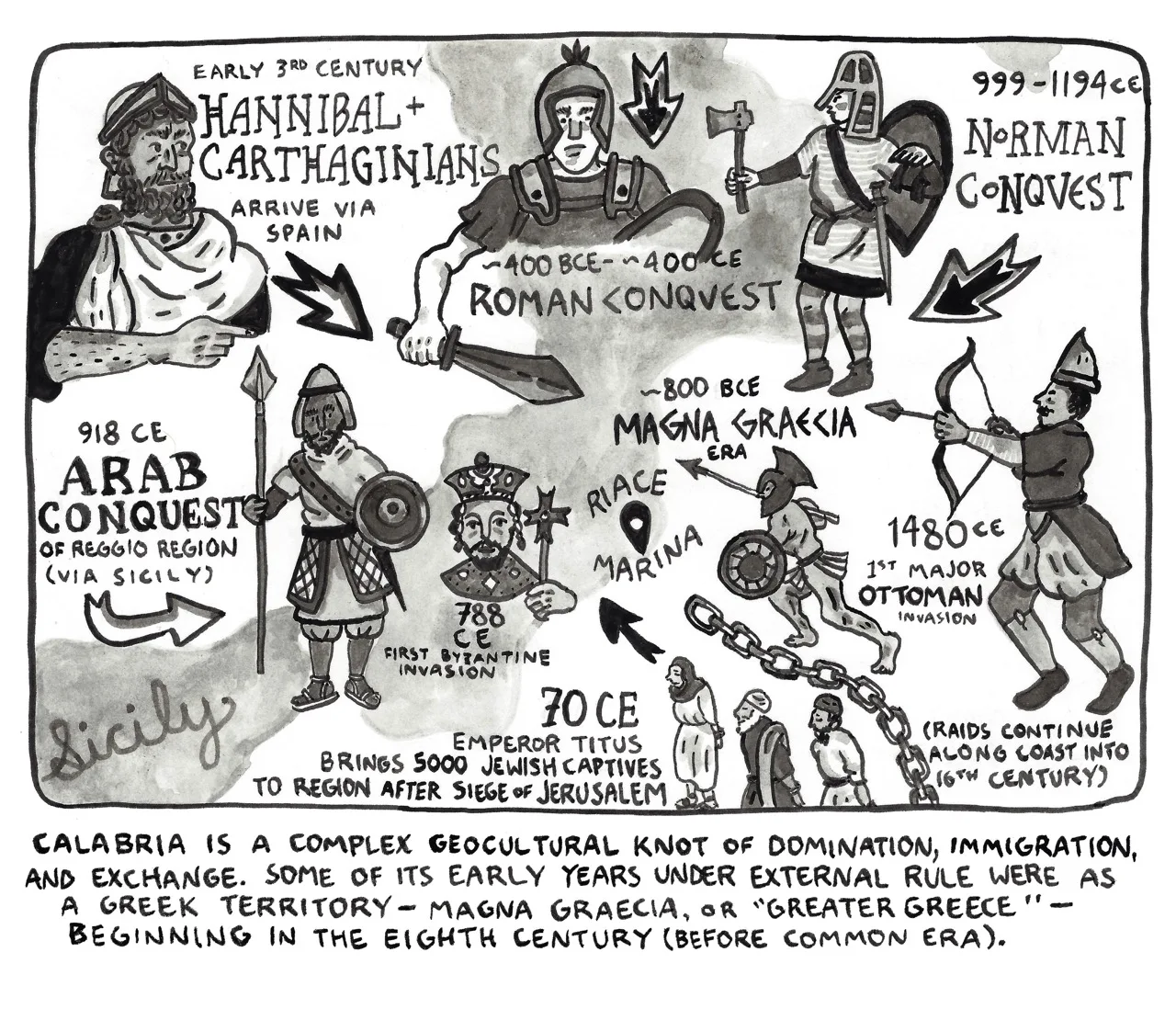
Panel 17 is a map showing Southern Italy, with the island of Sicily to the left and Albania and Greece to the right. Calabria is shaded darker than the rest of the map. The caption reads “Riace is located on the sole of Italy’s “boot,” in the region of Calabria.”
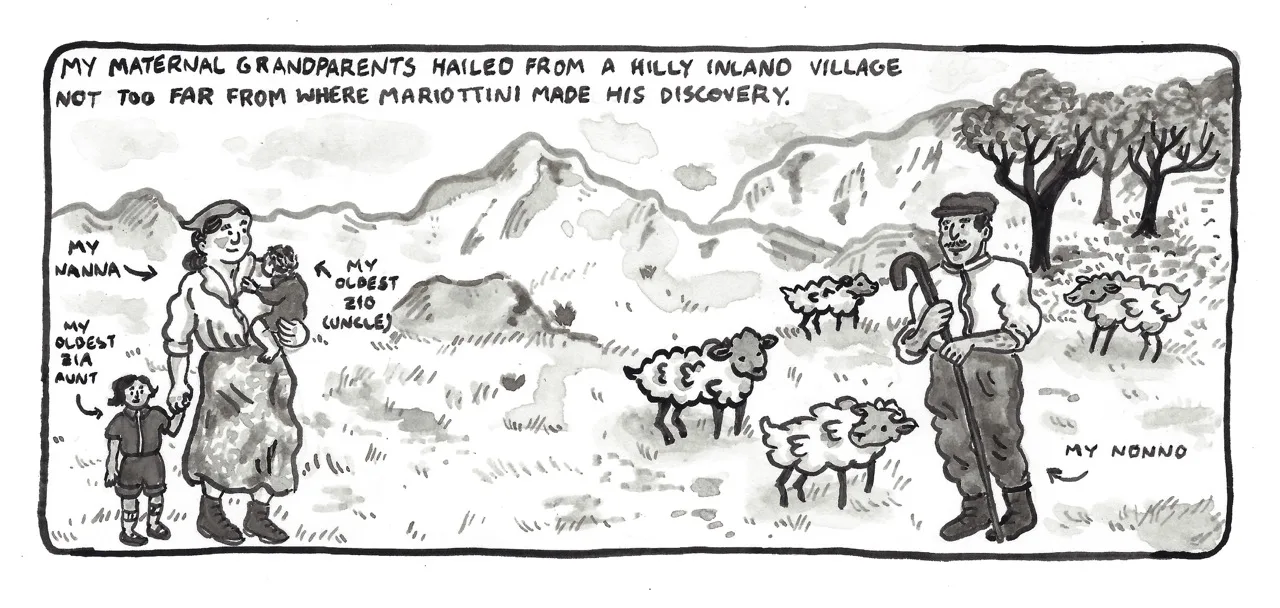
Panel 18 zooms in on Calabria, the Riace Marina indicated with an arrow. Several figures are superimposed over the map. Each figure represents a different era of the region’s history: We see Hannibal (text: “Early 3rd Century: Hannibal and the Carthaginians arrive via Spain”; a Roman legionnaire (text: “~400 BCE - ~400 CE Roman conquest”); a Norman warrior (text: “999-1194 CE Norman Conquest”); an Ottoman archer (text: “1480 CE: 1st major Ottoman invasion”); a Greek warrior (text: “~800 BCE: Magna Graecia era”), and Arab warrior (text: “918 CE: Arab conquest of Reggio Region, via sicily”); a Byzantine nobleman (text: “788 CE: first Byzantine invasion”); and a group of Jewish captives (text: “70 CE: Emperor Titus brings 5000 Jewish captives to region after siege of Jerusalem”). This map is followed by a caption which reads: “Calabria is a complex geocultural knot of domination, immigration, and exchange. Some of its early years under external rule were as a Greek territory — Magna Graecia, or “Greater Greece” — beginning in the eighth century (Before Common Era).Panel 19 is a wide landscape of rolling hills and olive trees. In the foreground is a light-skinned but tanned man with a mustache and a shepherd’s crook, surrounded by four sheep. The man is labelled with an arrow: “my nonno”. To the other side of the panel is a smiling, round-faced and light-skinned woman, carrying a baby in one arm and holding the hand of a little girl with a slightly darker complexion with the other. A label indicates that she is my nanna, with others indicating the baby is my oldest zio, or uncle, and the little girl is my oldest zia, or auntie. The caption reads: “My maternal grandparents hailed from a hilly inland village not too far from where Mariottini made his discovery.”
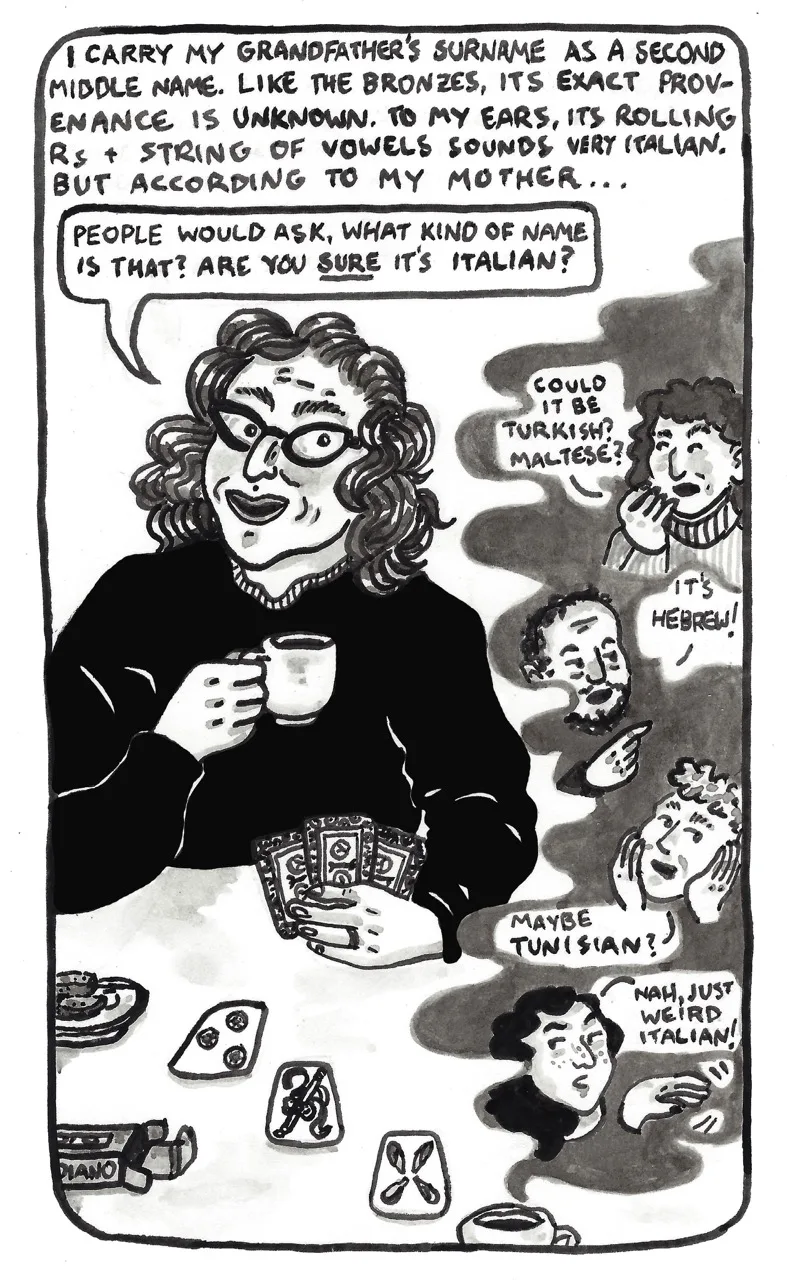
Panel 20 begins with the caption “I carry my grandfather’s surname as a second middle name. Like the Bronzes, its exact provenance is unknown. To my ears, its rolling Rs and string of vowels sound very Italian. But according to my mother…”. The panel shows a light-skinned woman with dark hair and glasses playing Italian cards and drinking an espresso. She smiles as she recalls “People would ask, what kind of name is that? Are you sure it’s Italian?” To the side of her, a plume of steam rises from another espresso cup. This plume contains four figures, who speculate on the name’s origin: “Could it be Turkish? Maltese?”, asks one. Another points, claiming “It’s Hebrew!”. A third speculates, “Maybe Tunisian?”. A fourth waves a dismissive hand: “Nah, just weird Italian!”.
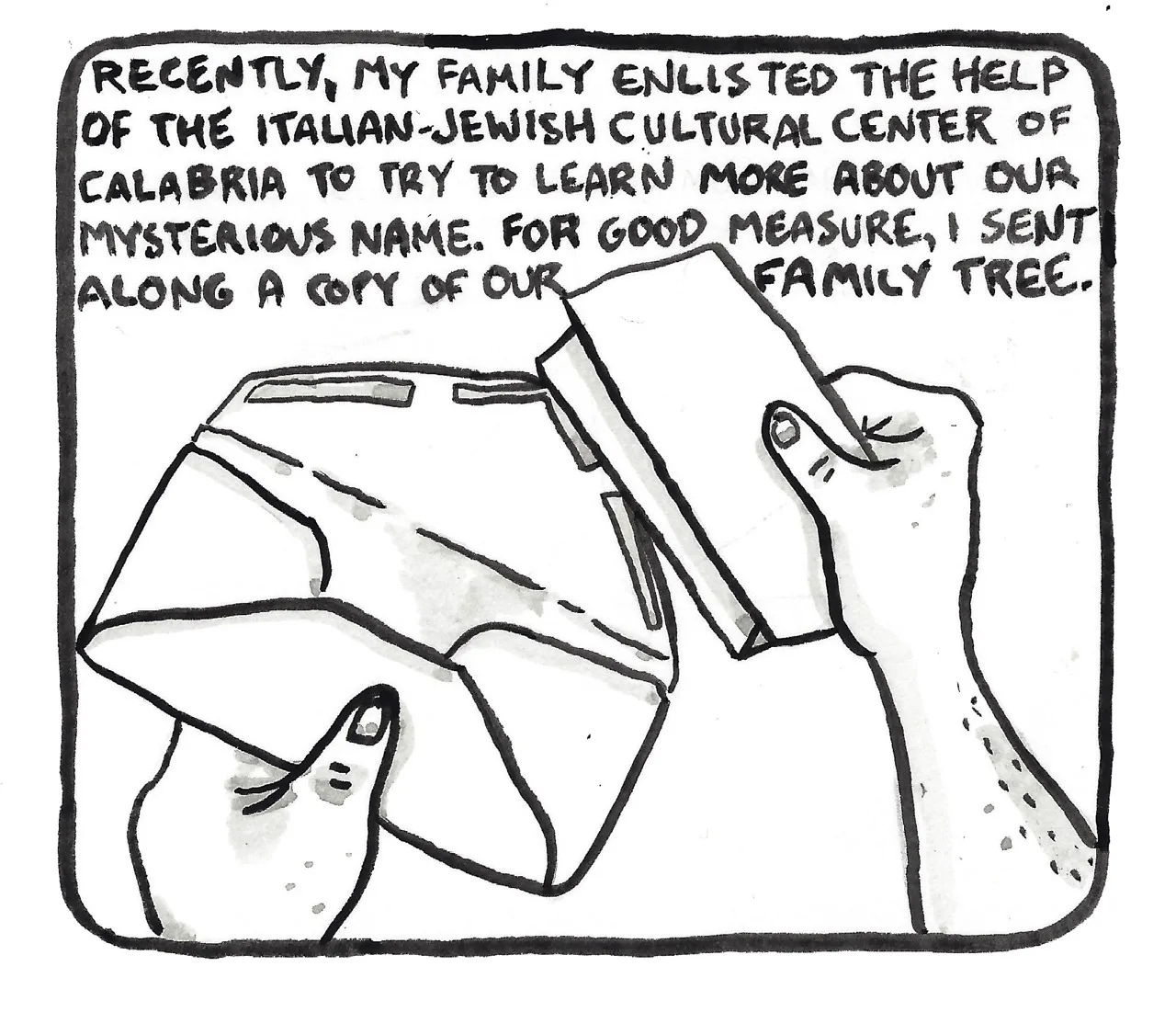
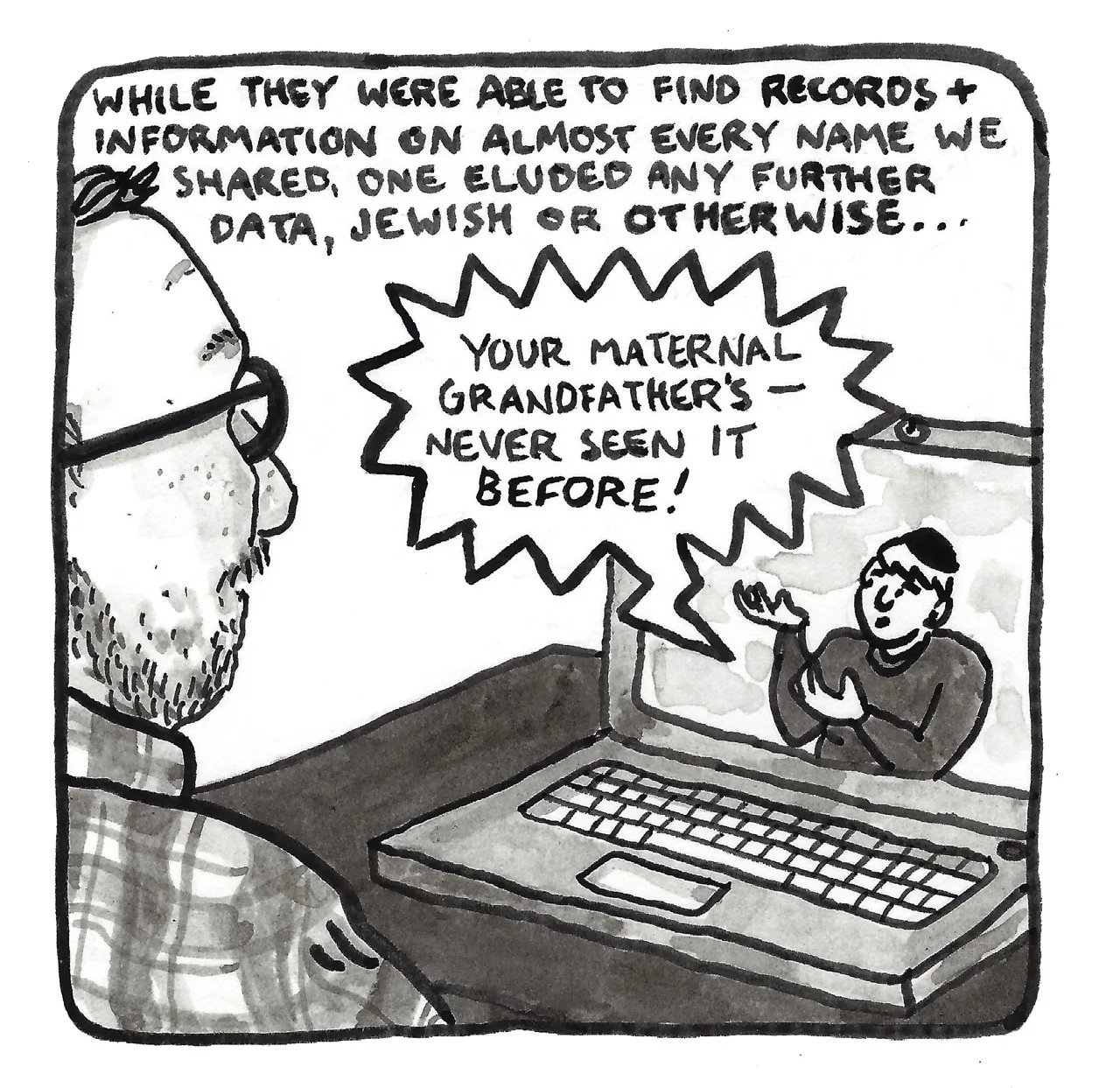
Panel 21 shows a pair of hands tucking a folded piece of paper into an envelope. The caption reads: “Recently, my family enlisted the help of the Italian-Jewish Cultural Center of Calabria to try to learn more about our mysterious name. For good measure, I sent along a copy of our family tree.”Panel 22 shows Cesario, the author of the comic, on a zoom call with a short-haired rabbi. Cesario is light-haired and light-skinned, with freckles and glasses. The caption reads “While they were able to find records and information on almost every name we shared, one eluded any further data, Jewish or otherwise…”. The rabbi shrugs and says “Your maternal grandfather’s — never seen it before!”
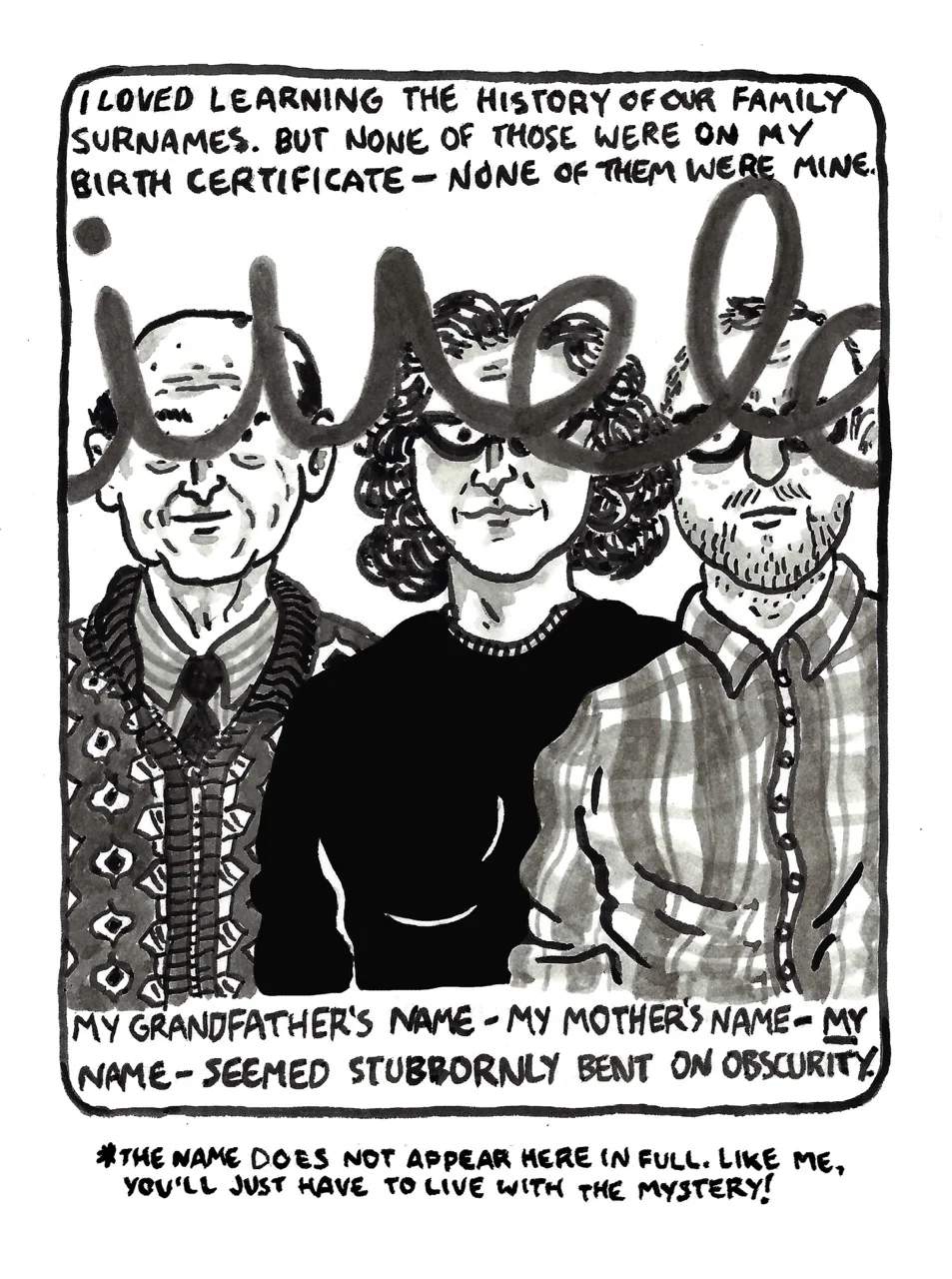
Panel 23 begins with the caption “I loved learning the history of our family surnames. But none of those were on my birth certificate - none of them were mine.” Three figures stand shoulder to shoulder: Cesario’s nonno, now aged, Cesario’s mother, and Cesario. Obscuring their eyes are looping fragments of the mysterious last name: we see only the letters i, u, e, l, e. The caption continues, “My grandfather’s name — my mother’s name — my name — seemed stubbornly bent on obscurity.”
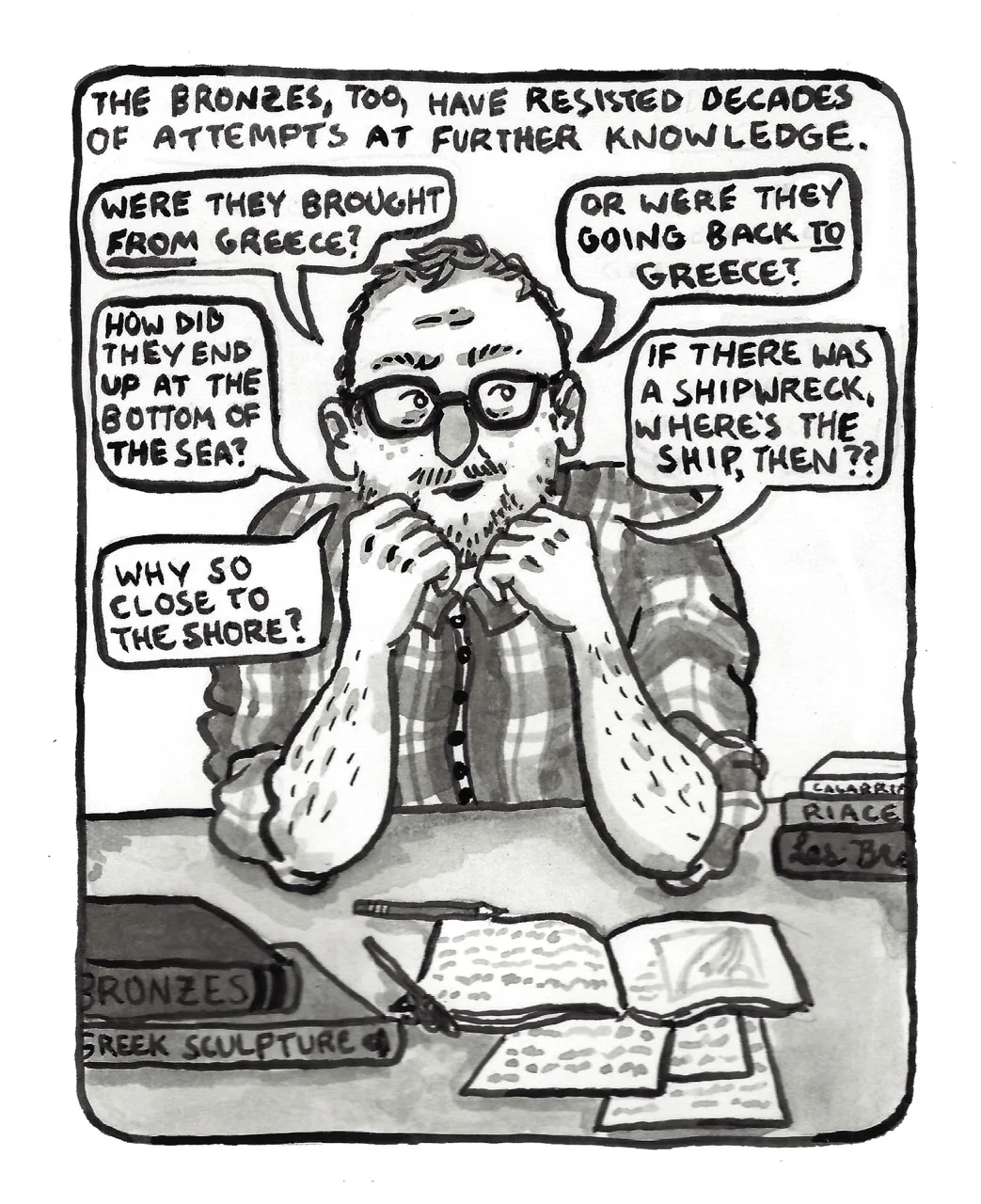
Panel 24 shows Cesario at his desk, resting his chin on his hands. Stacks of books and papers litter the desk. The text reads, “The Bronzes, too, have resisted decades of attempts at further knowledge.” Cesario emits several speech bubbles, which read: “Were they brought from Greece? … Or were they going back to Greece? How did they end up at the bottom of the sea? If there was a shipwreck, where’s the ship, then?? Why so close to the shore?”
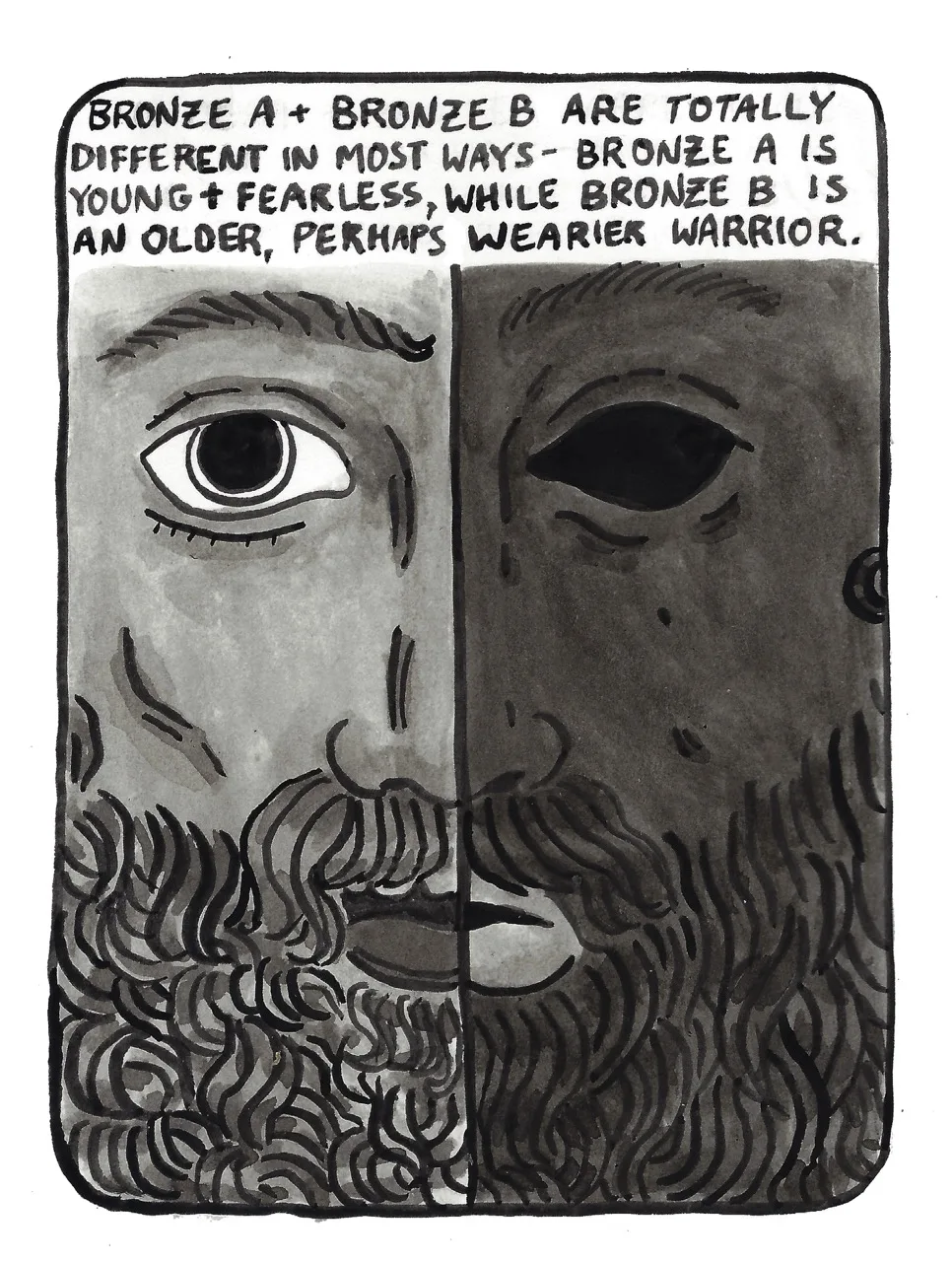
Panel 25 is split in two, showing Bronze A’s face on one side and Bronze B’s on the other. The text reads “Bronze A and Bronze B are totally different in most ways — Bronze A is young and fearless, while Bronze B is an older, perhaps wearier warrior.”
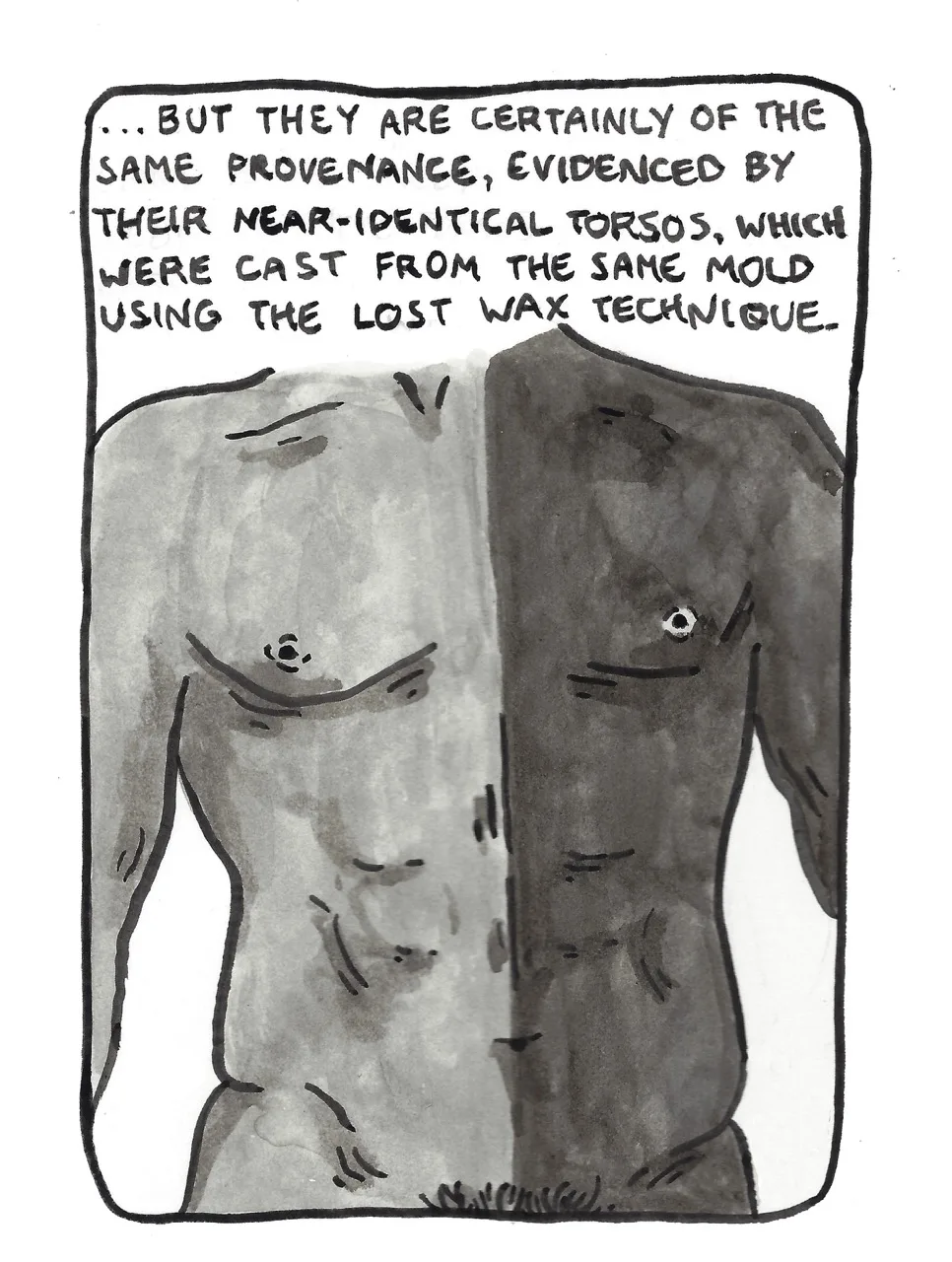
Panel 26 is likewise split, this time showing half of Bronze A’s torso, and half of Bronze B’s. The caption reads “But they are certainly of the same provenance, evidenced by their near-identical torsos, which were cast from the same mold using the lost wax technique.”
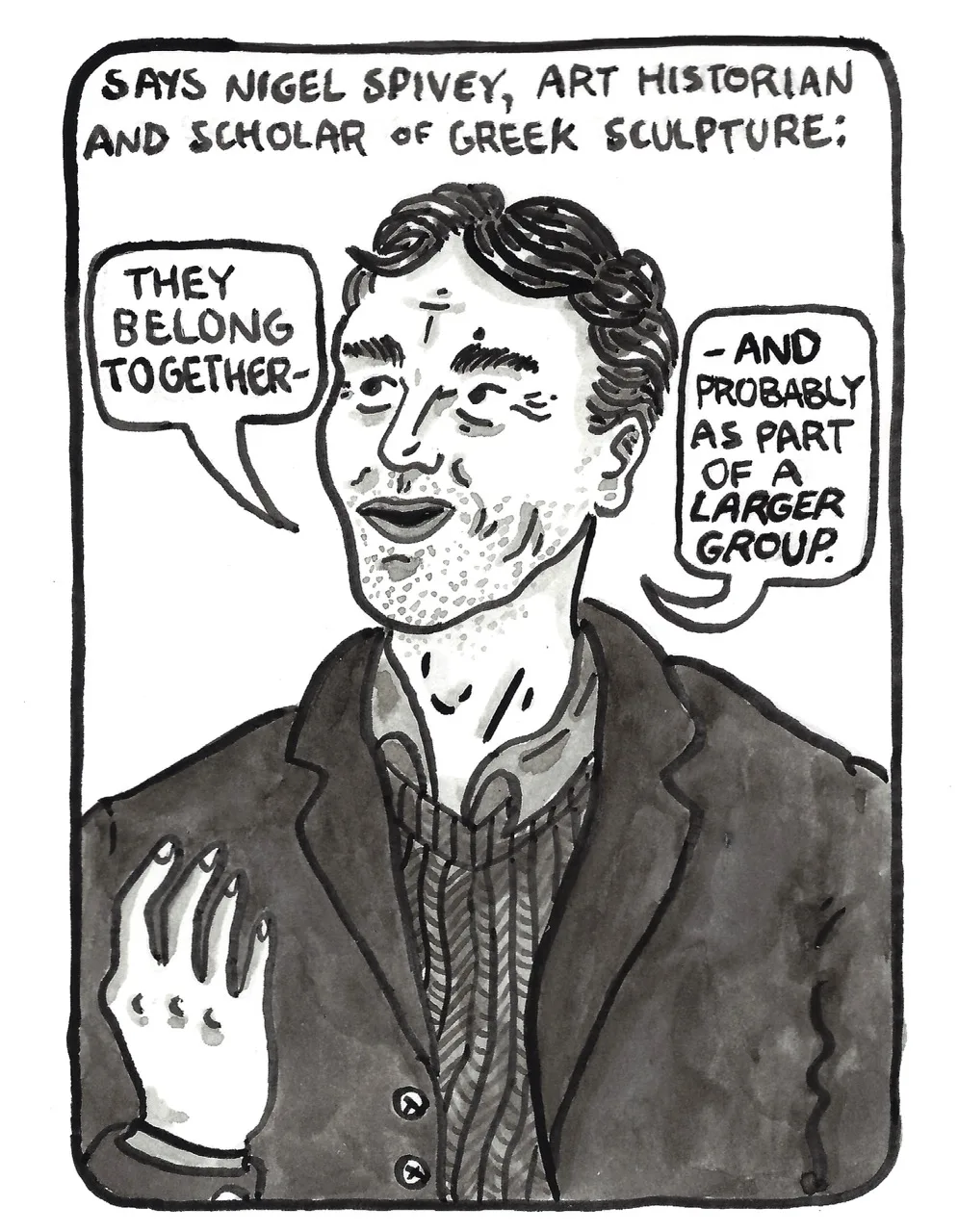
Panel 27’s text reads “Says Nigel Spivey, art historian and scholar of Greek sculpture:”, next showing a light-skinned middle-aged man who says “They belong together — and probably as part of a larger group.”
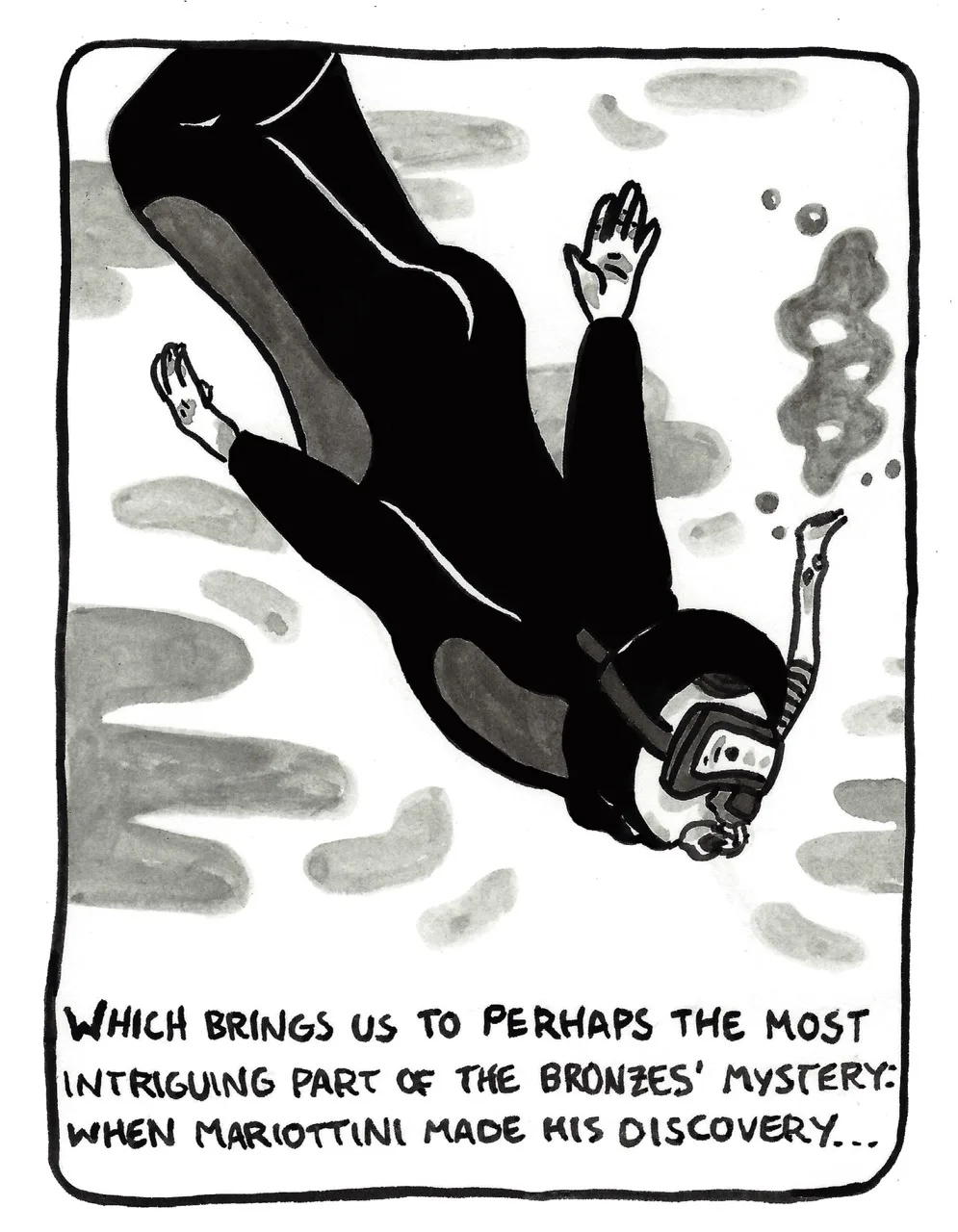
Panel 28 shows Mariottini diving down into the sea. The caption reads “Which brings us to perhaps the most intriguing part of the Bronzes’ mystery: When Mariottini made his discovery…
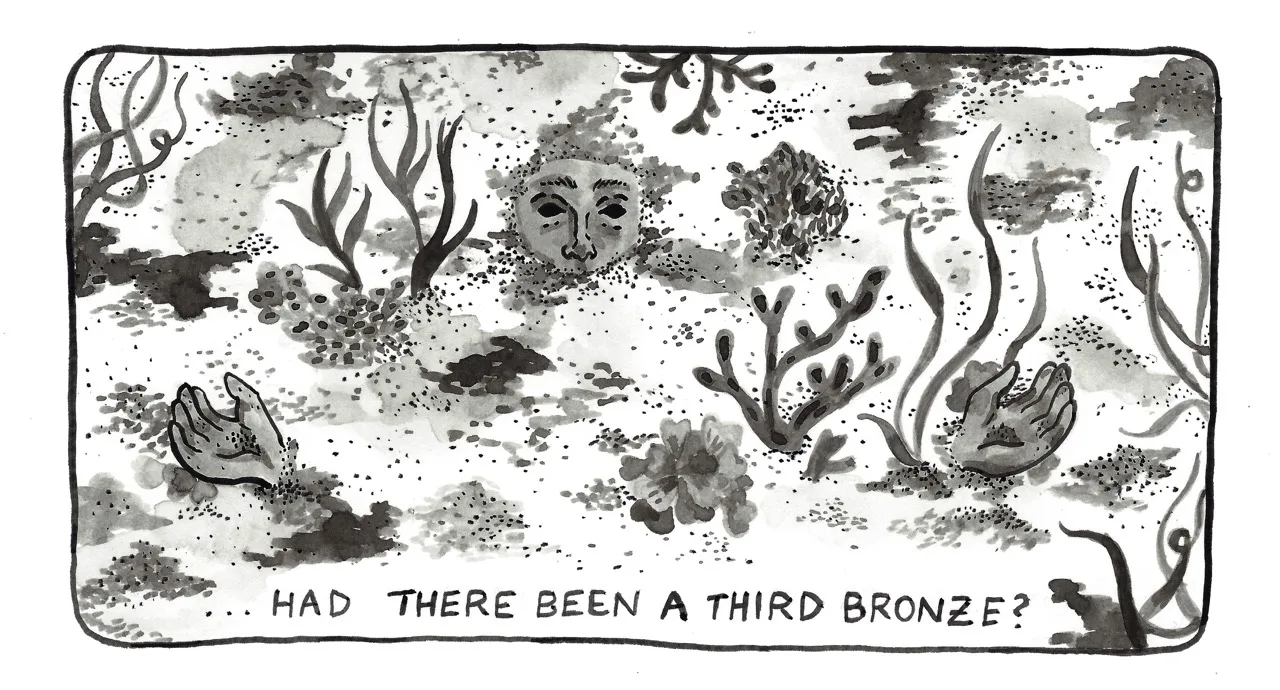
Panel 29 is a wide panel of the sea floor, two hands and part of a face eerily emerging from the sand. The caption reads “...had there been a third bronze?”
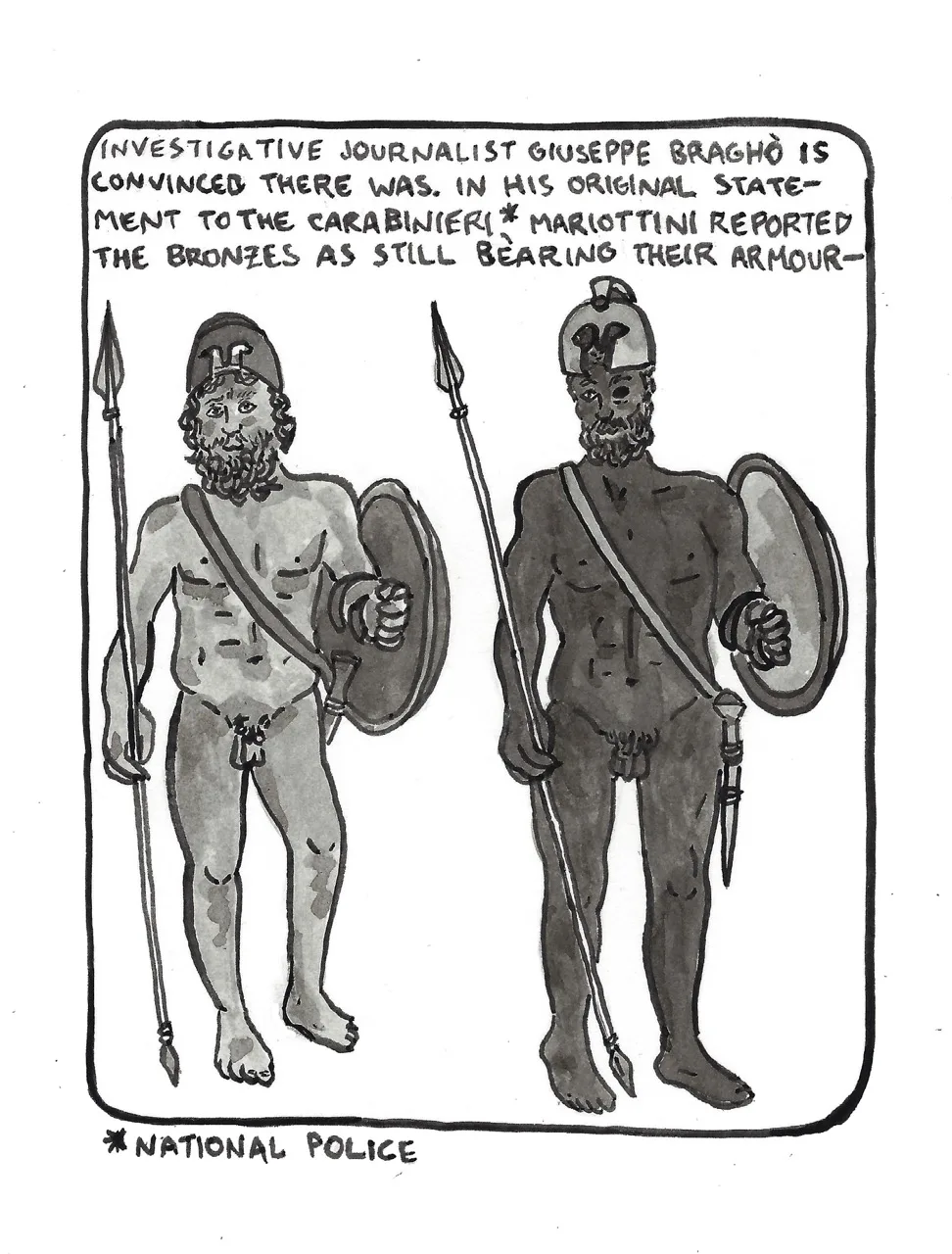
Panel 30 is captioned “Investigative journalist Giuseppe Braghò is convinced there was. In his original statement to the Carabinieri (national police), Mariottini reported the Bronzes as still bearing their armour —”. The two bronzes are shown, wearing helmets and bearing shields, spears, and swords.
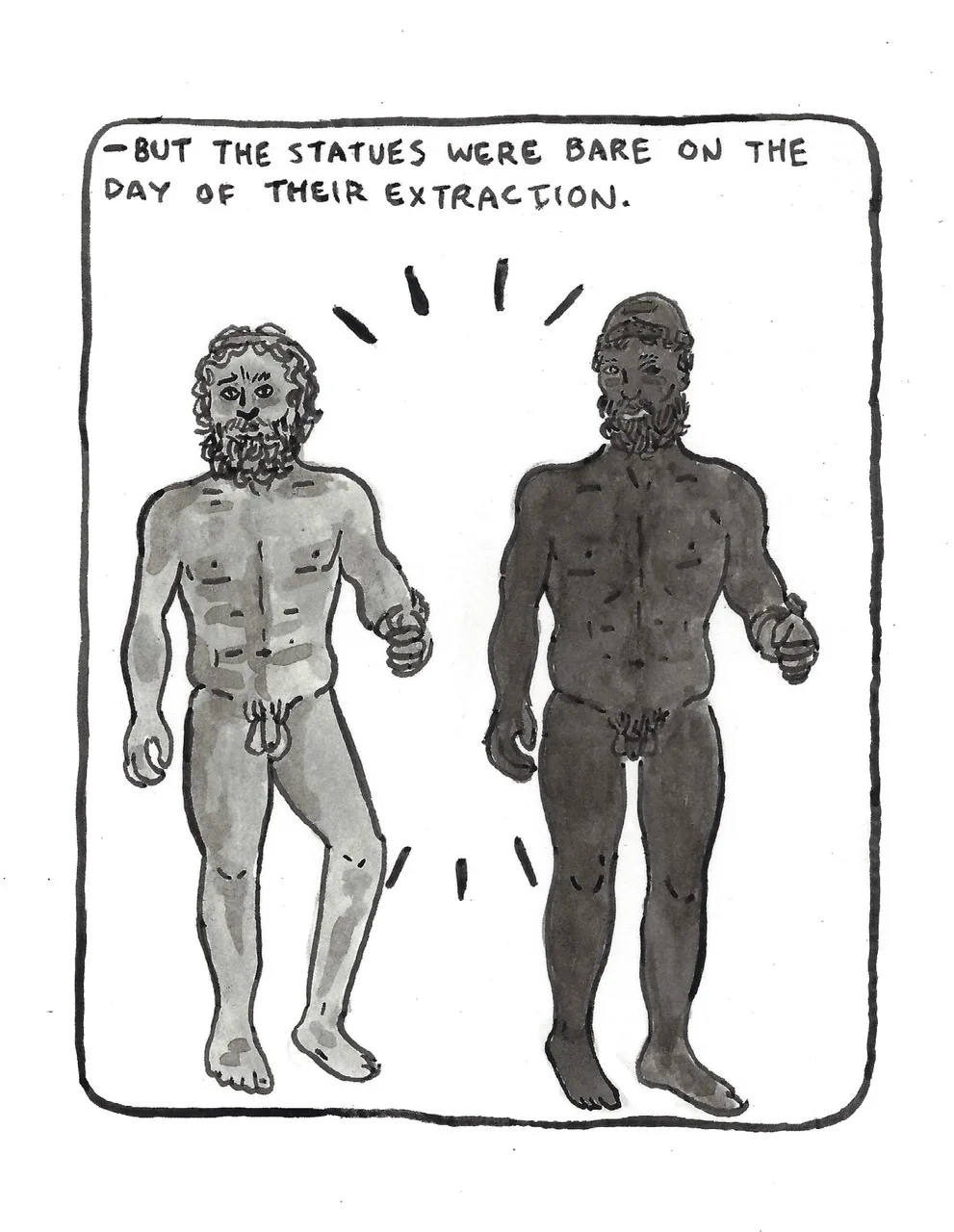
Panel 31 reads “— But the statues were bare on the day of their extraction,” showing the Bronzes in the same position, only this time bare.
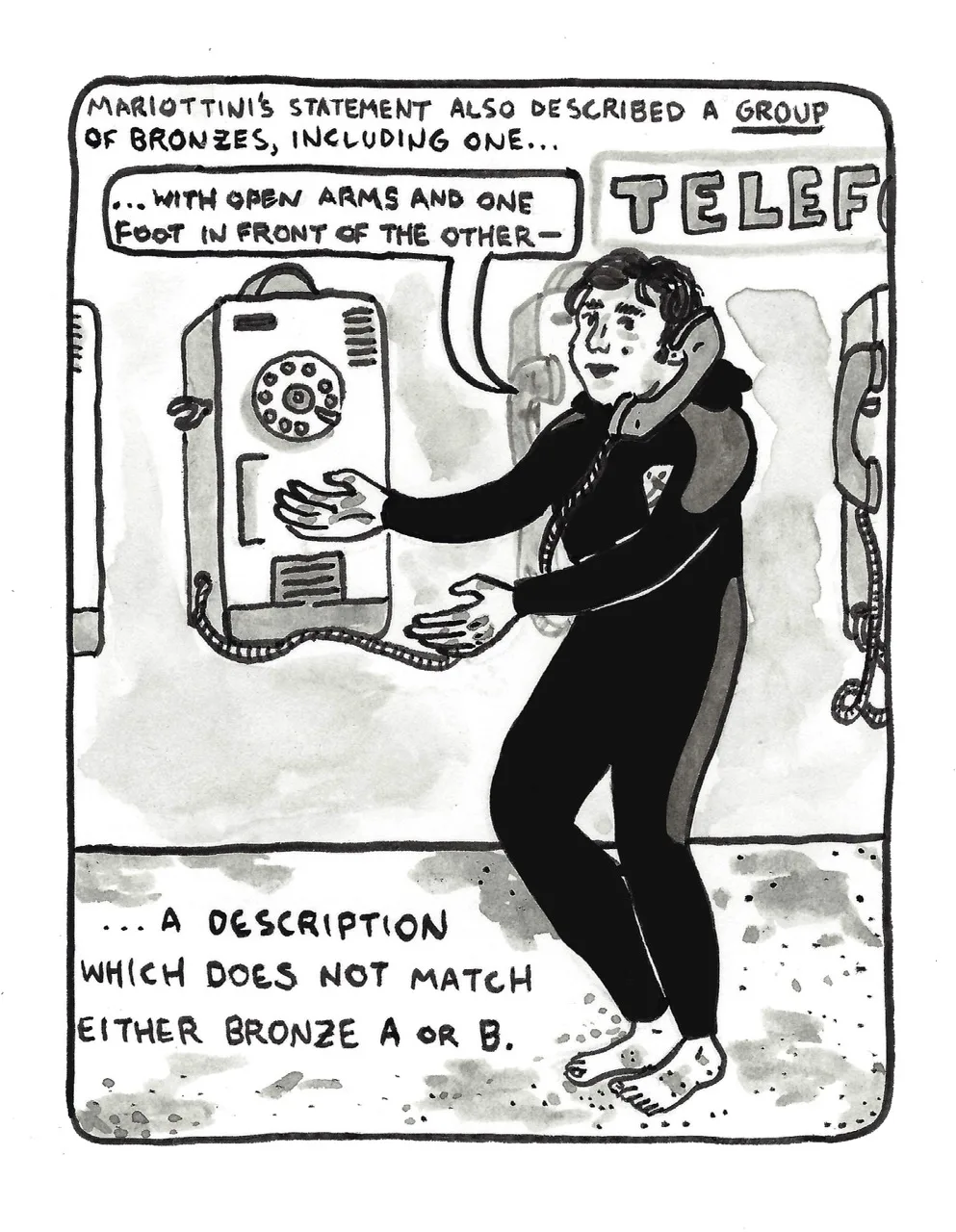
Panel 32’s text begins “Mariottini’s statement also described a group of bronzes, including one…”. Mariotiottini stands at a bank of payphones on the beach, still in his wetsuit. Cradling the phone between his cheek and shoulder, he gestures with his arms outstretched and says “...with open arms and one foot in front of the other —”. The caption continues “...a description which does not match either Bronze A or B.”
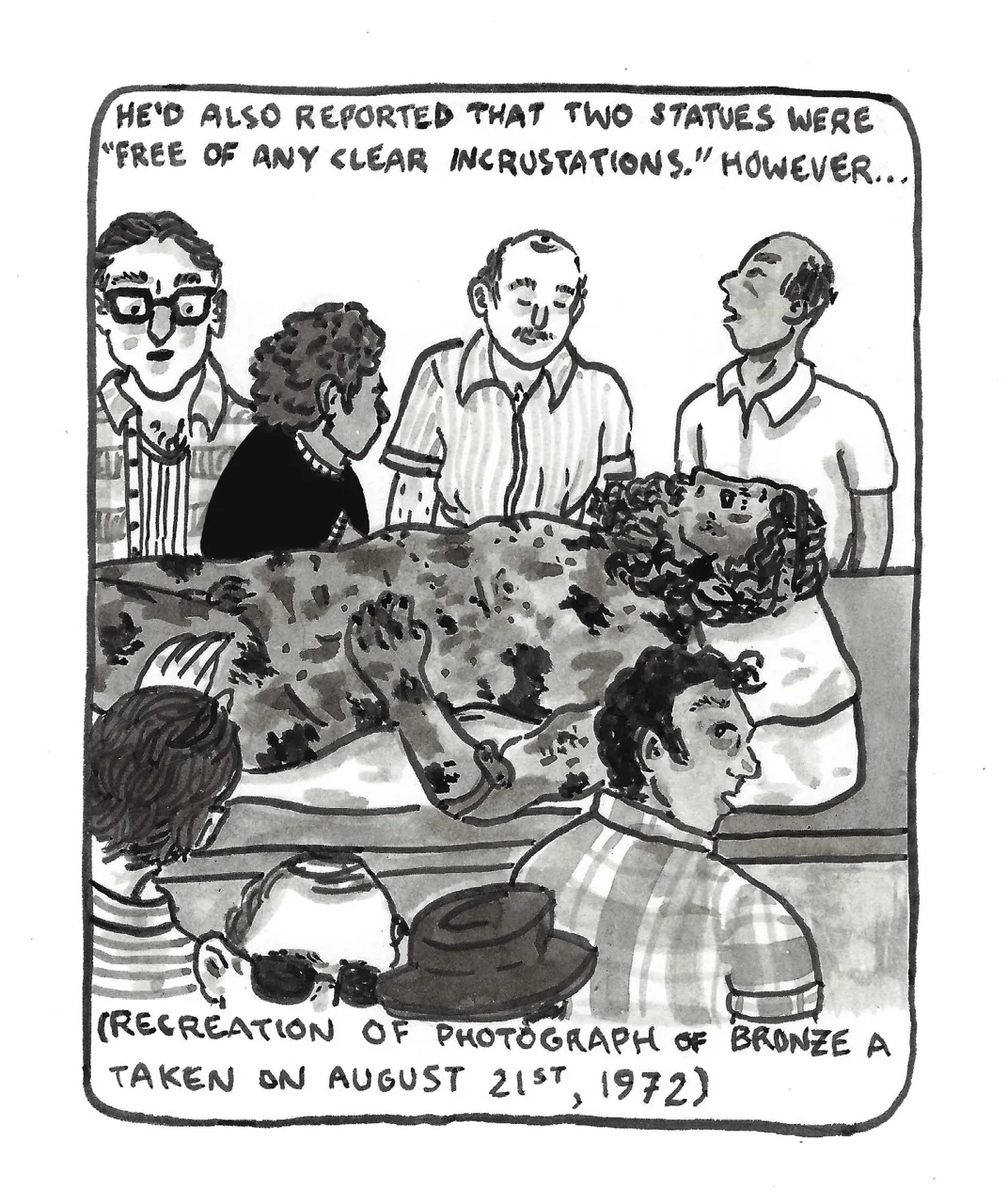
Panel 33's text begins “He’d also reported that two statues were “Free of any clear incrustations.” However…”, next showing a group of people standing over a supine Bronze A, clearly covered in incrustations. A second caption reads “Recreation of photograph of Bronze A taken on August 21st, 1972).
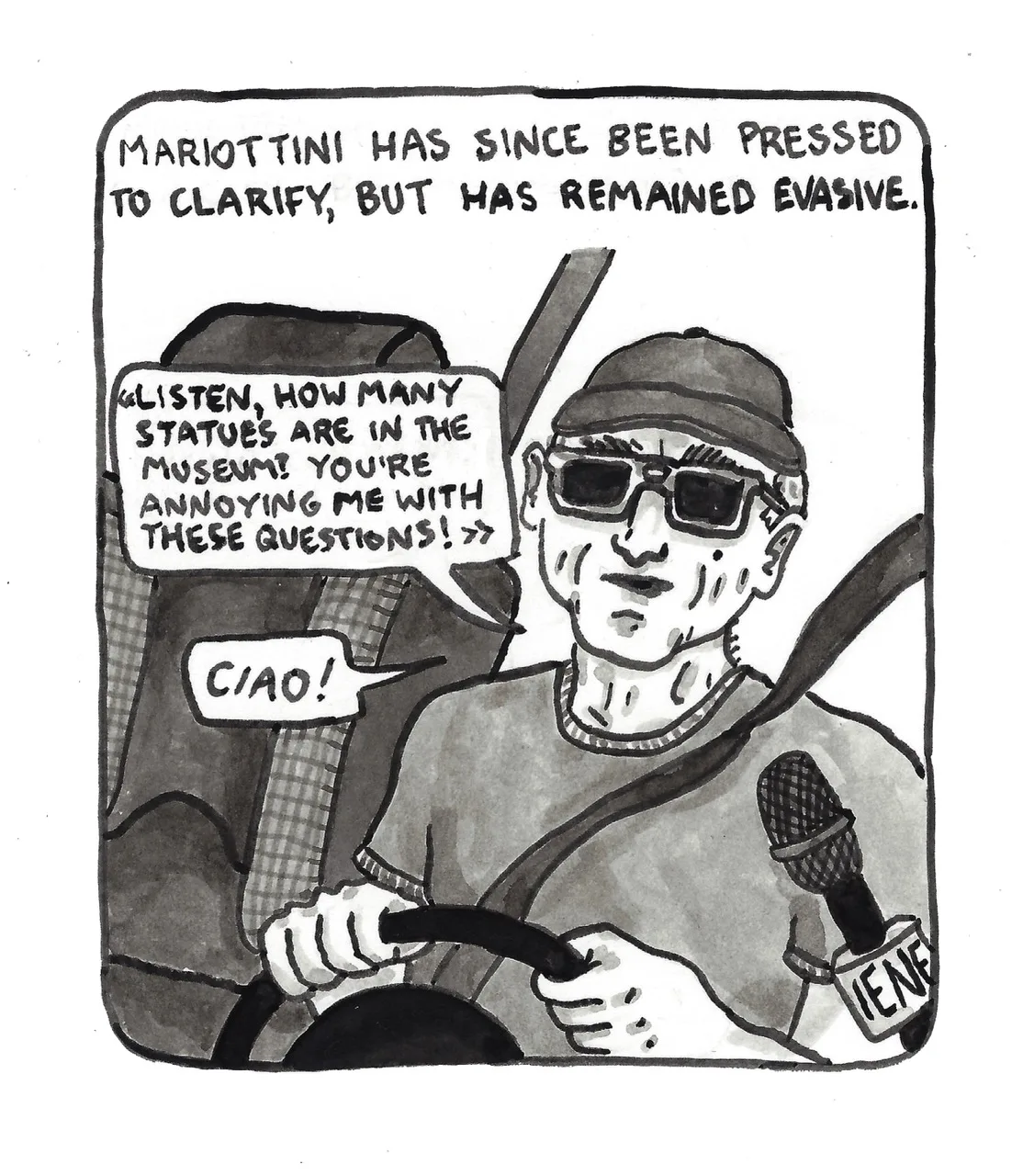
Panel 34 shows Mariottini, now aged and sporting a baseball cap and sunglasses, sitting in his car gripping the steering wheel. A microphone is being pushed through the window. Irritated, he snaps, “Listen, how many statues are in the museum? You’re annoying me with these questions! Ciao!” The caption reads “Mariottini has since been pressed to clarify, but has remained evasive.”
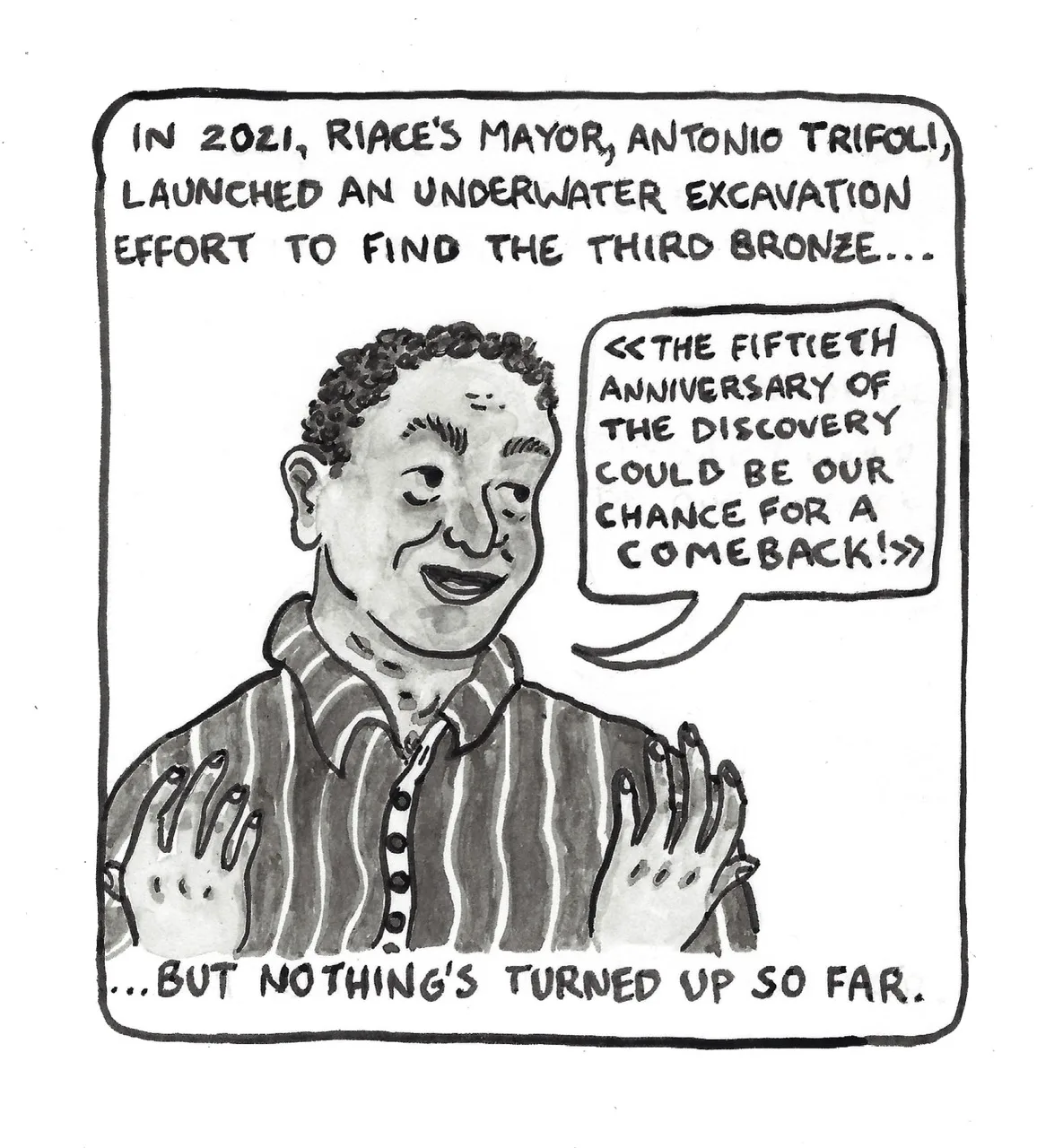
Panel 35 reads, “In 2021, Riace’s mayor, Antonio Trifoli, launched an underwater excavation effort to find the third Bronze…”. A man with olive skin and tight curls smiles, exclaiming “The fiftieth anniversary of the discovery could be our chance for a comeback!”. The caption continues, “...But nothing’s turned up so far.”
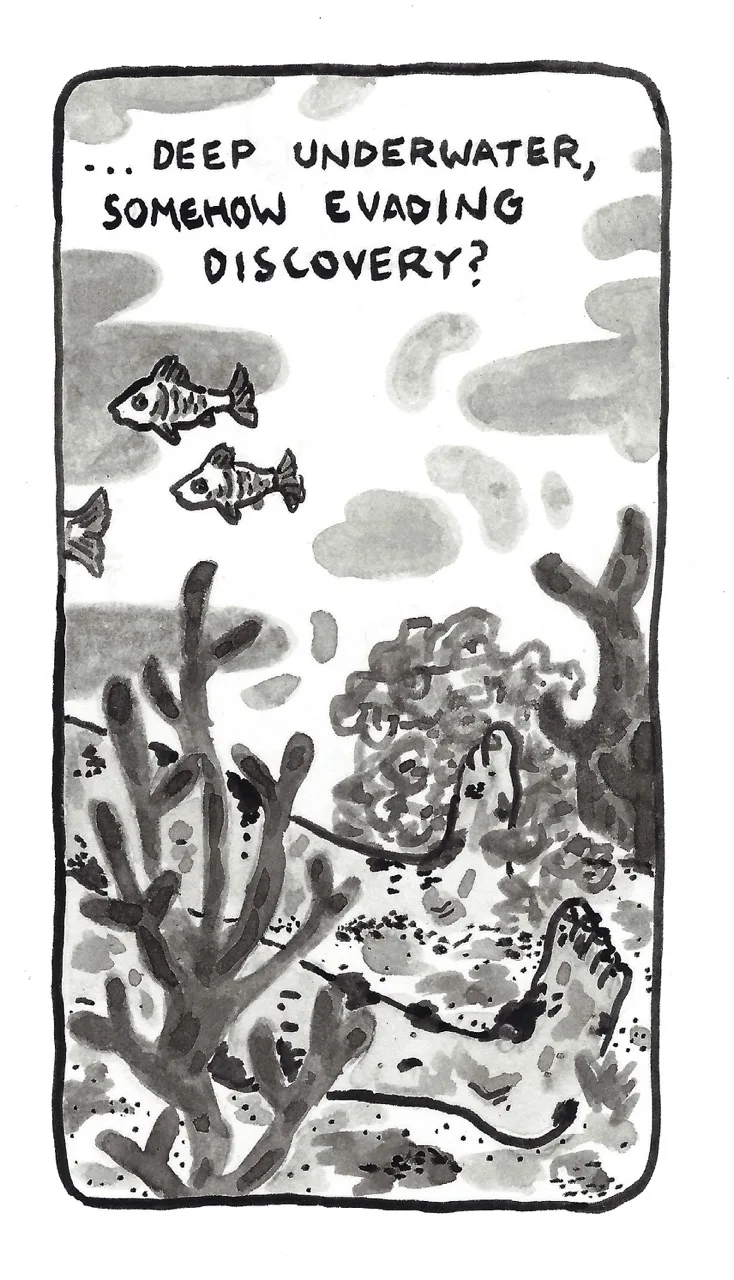
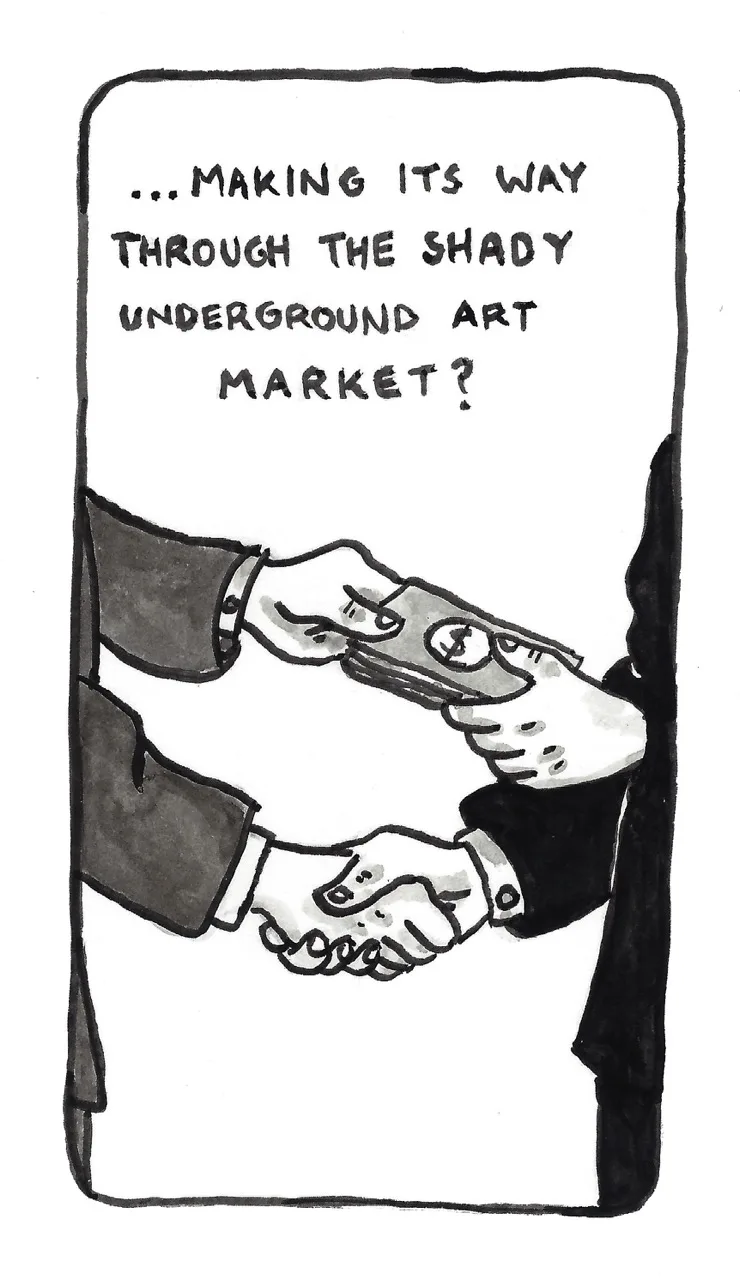
Panels 36, 37 and 38 are a triptych, under a caption which reads “So where is the third Bronze?”
Panel 36 is an underwater scene, with fish and aquatic vegetation partially obscuring two legs. The text reads “...deep underwater, somehow evading discovery?”
Panel 37 shows the hands of two business men, shaking one another’s right hands while their left hands exchange a wad of cash. The caption reads “...making its way through the shady underground art market?”
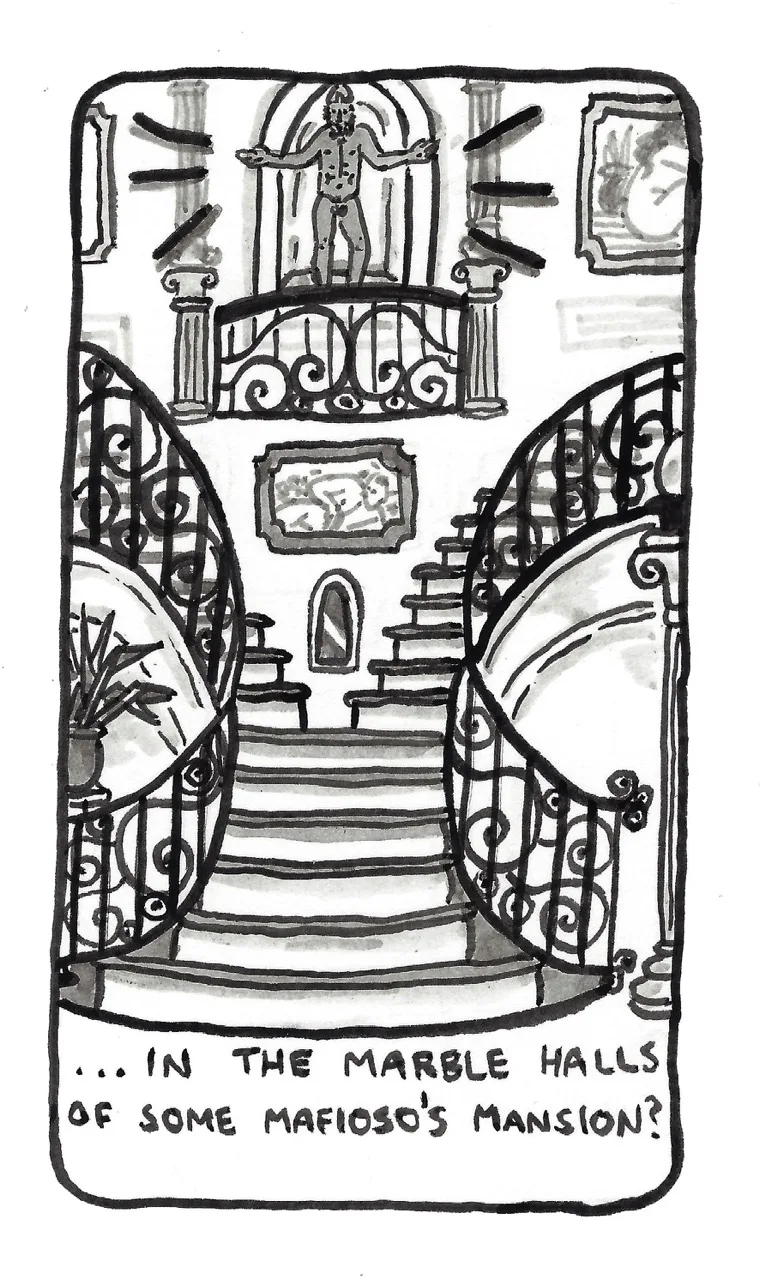
Panel 38 shows a gaudy mansion with a spiral staircase leading in two directions. On a small balcony, a bronze statue with open arms perches. The text reads, “...in the marble halls of some mafioso’s mansion?”
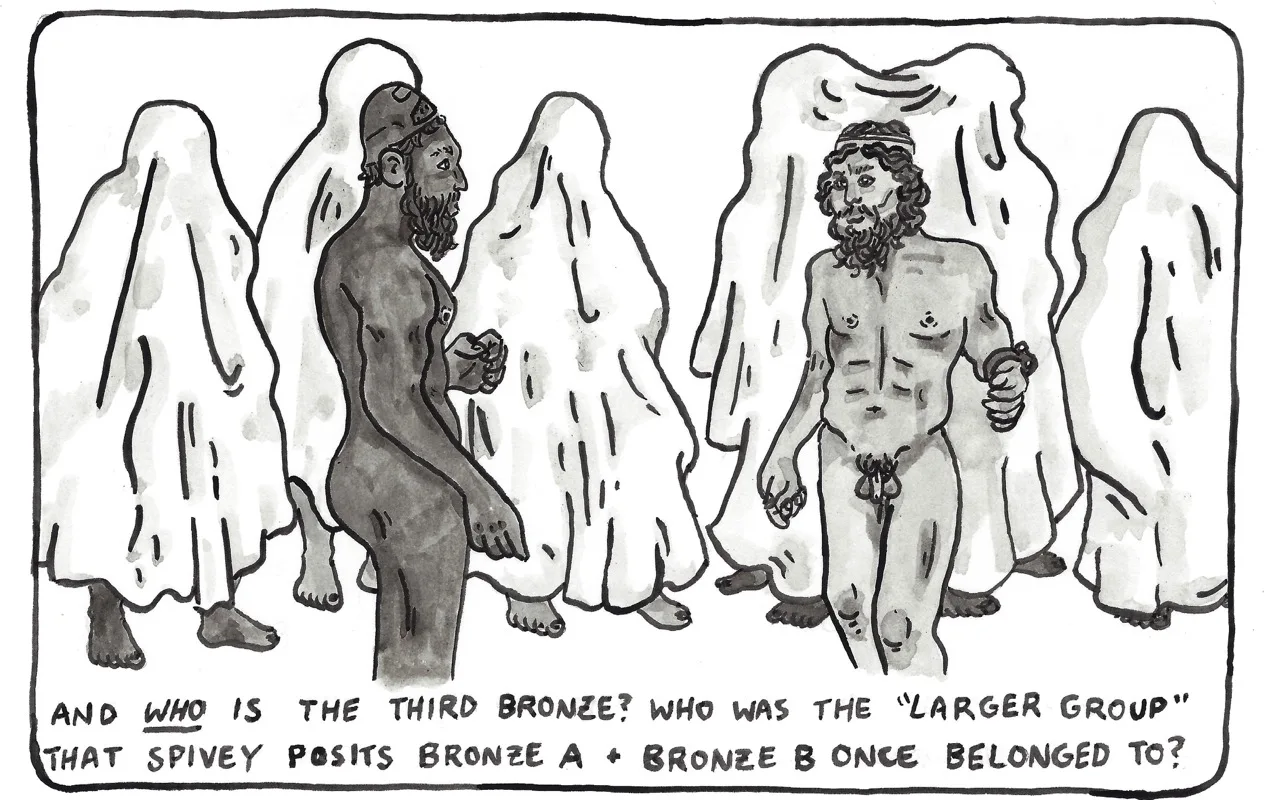
Panel 39 is a wide shot of Bronzes B and A facing one another. Behind them are several other sculptures, all hidden beneath white sheets draped over them. The text reads, “And who is the third bronze? Who was the “larger group” that Spivey posits Bronze A and Bronze B once belonged to?”Panels 40, 41 and 42 are another triptych, under a caption which reads “ The Bronzes have been dated to ~450 BCE. There are three groupings of Greek bronze statues from this period that we have records of:”
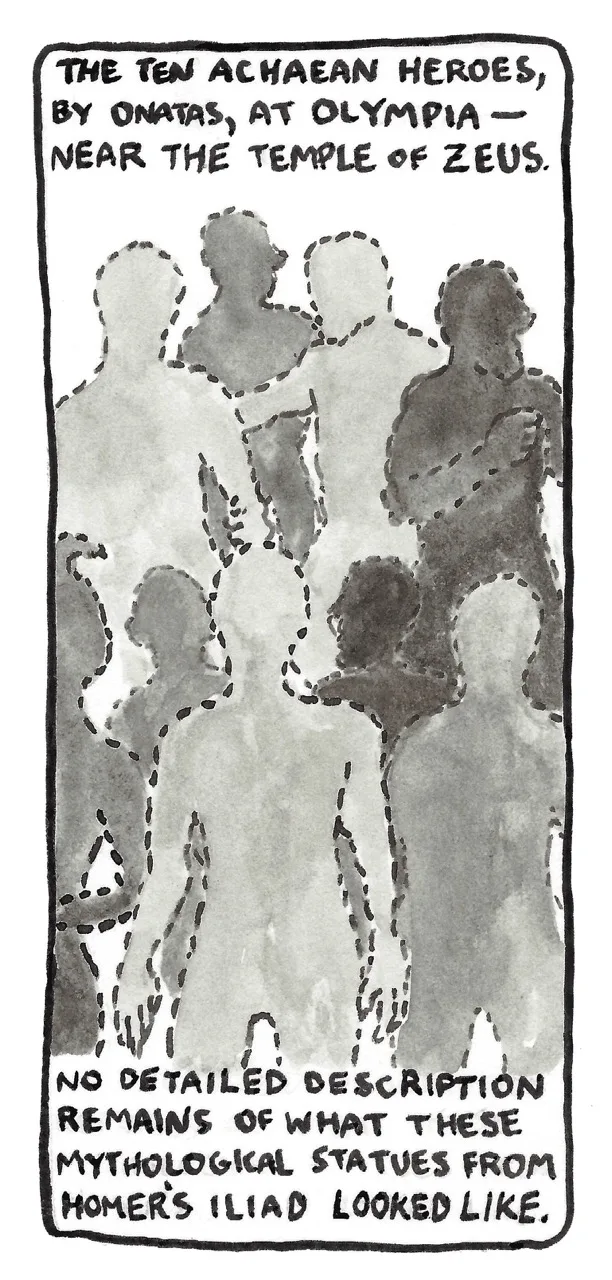
Panel 40 shows the dotted outlines of ten statues, the caption reading “The ten Achaean Heroes, by Onatas, at Olympia — near the temple of Zeus. No detailed description remains of what these mythological statues from Homer’s Iliad looked like.”
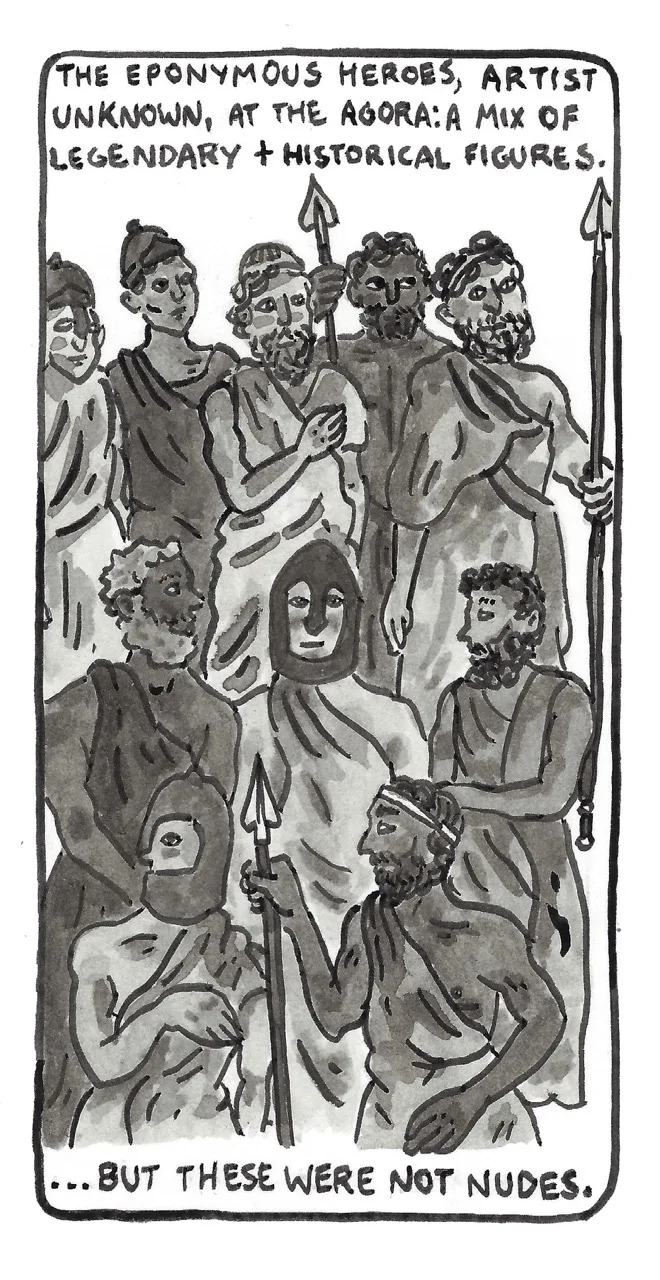
Panel 41 shows a group of ten statues, each draped in a tunic, many wearing helmets or bearing spears. The caption reads “The Eponymous Heroes, artist unknown, at the Agora: a mix of legendary and historical figures…but these were not nudes.”
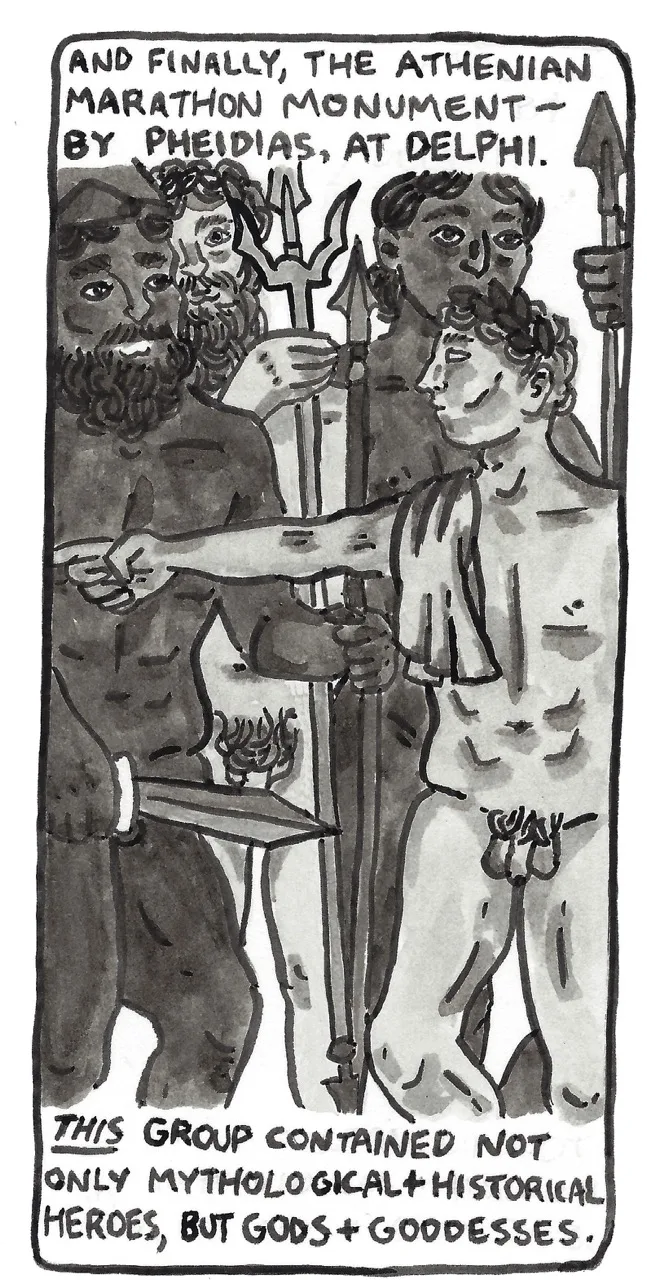
Panel 42 shows four statues. One wears a laurel crown and points; another carries a trident. One looks quite like Bronze B, bearing a spear and sword. Another is a woman with long hair in a bun. The text reads “and finally, the Athenian Marathon Monument — by Pheidias, at Delphi. This group contained not only mythological and historical heroes, but gods and goddesses.”
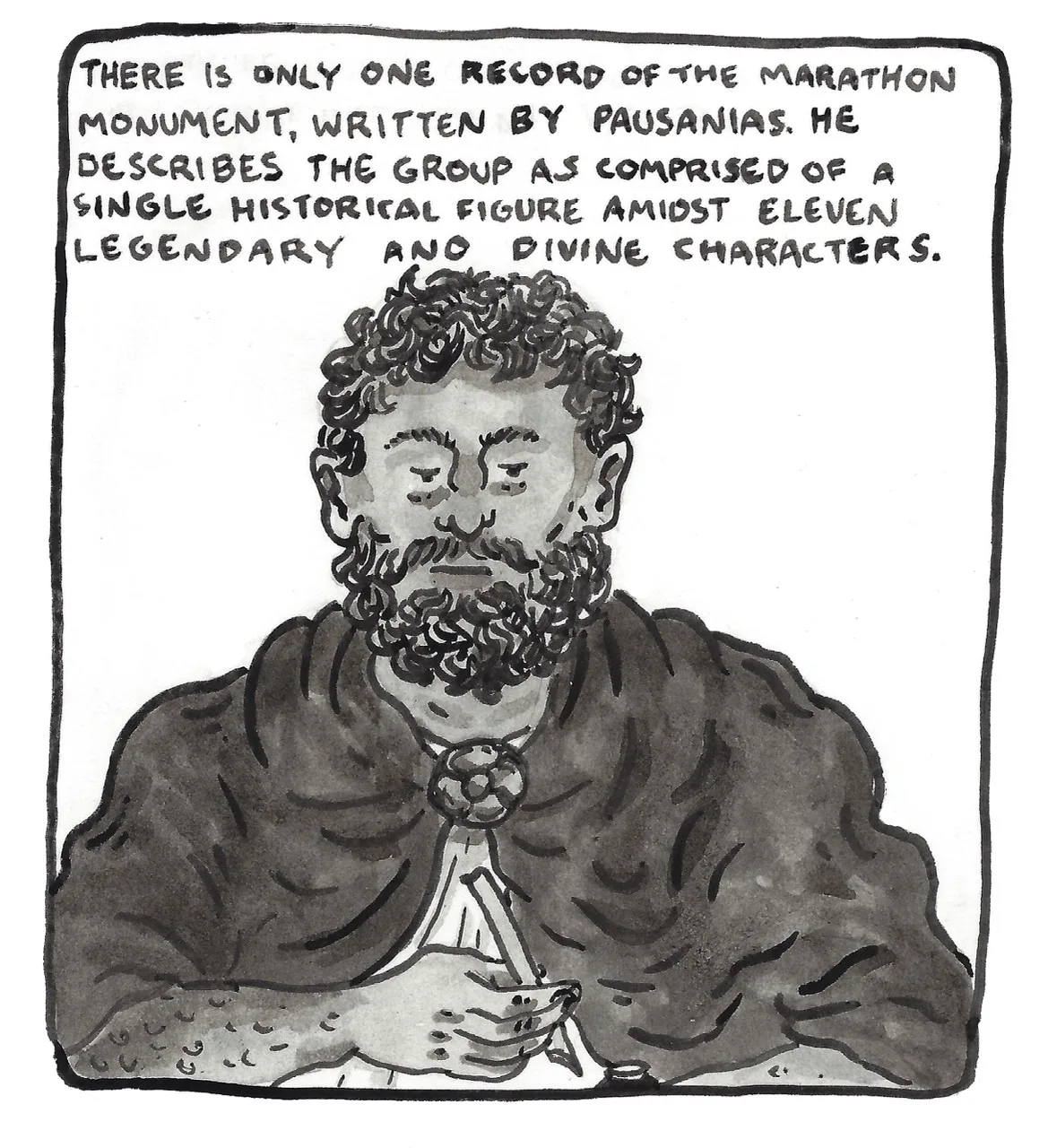
Panel 43 is captioned “There is only one record of the Marathon Monument, written by Pausanias. He describes the group as comprised of a single historical figure amidst eleven legendary and divine characters.” Pausanias, a Lydian-Greek scholar with dark olive skin, curly hair, and a beard, concentrates as he writes with a reed pen.
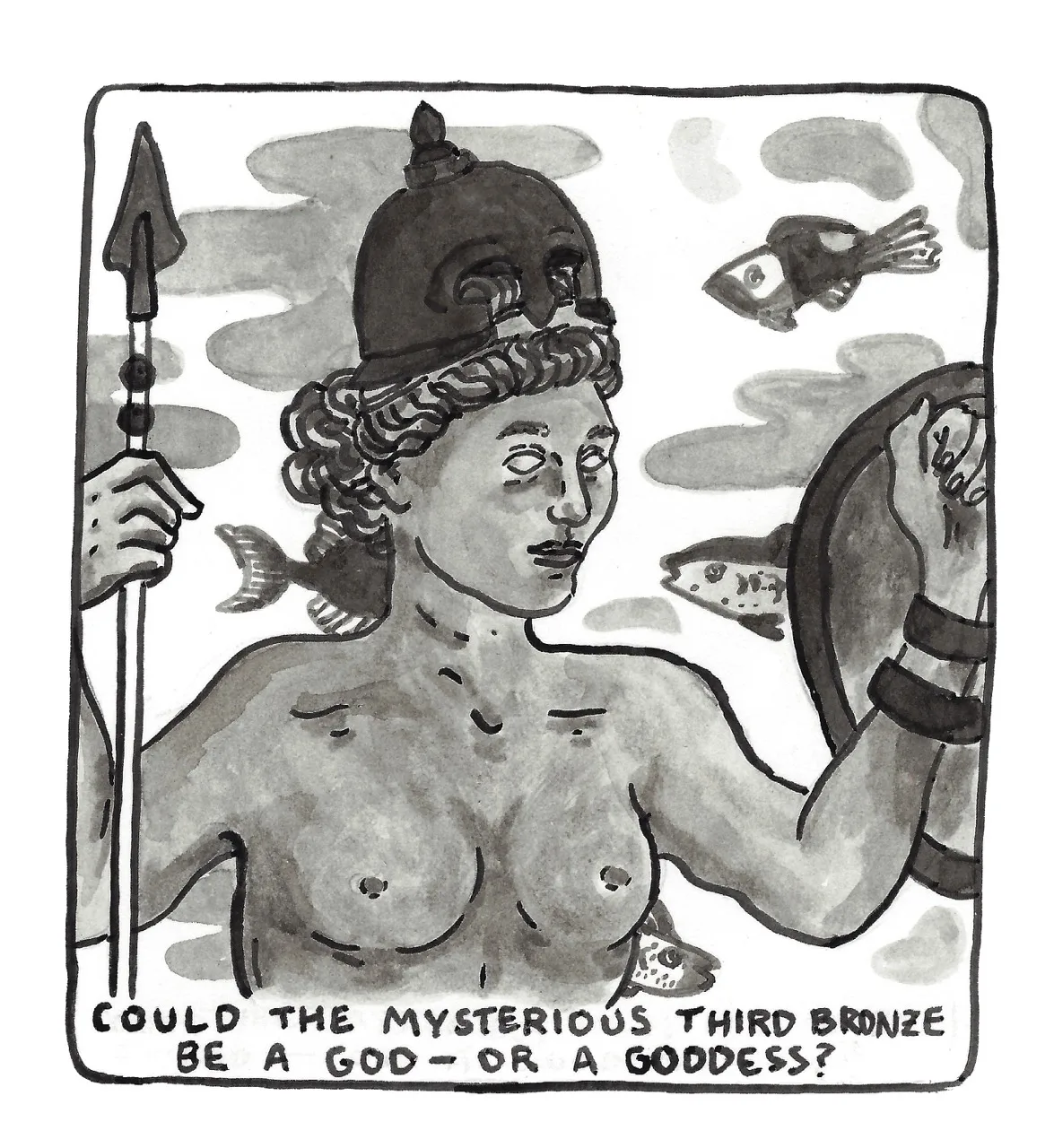
Panel 44 shows a statue of the goddess Athena, wearing a helmet and bearing a shield and spear in each of her open arms. She is underwater; fish swim by in the background. The caption reads “could the mysterious third Bronze be a god — or a goddess?”
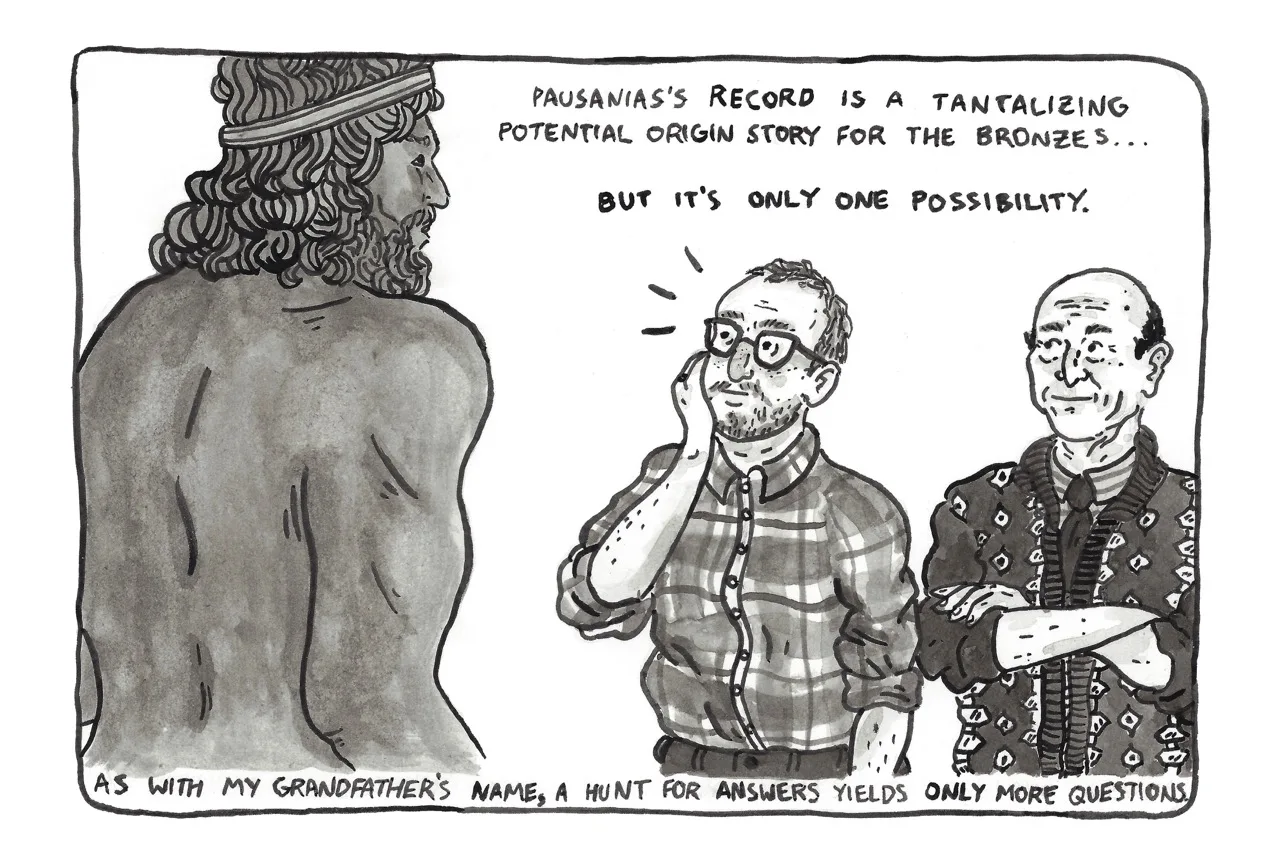
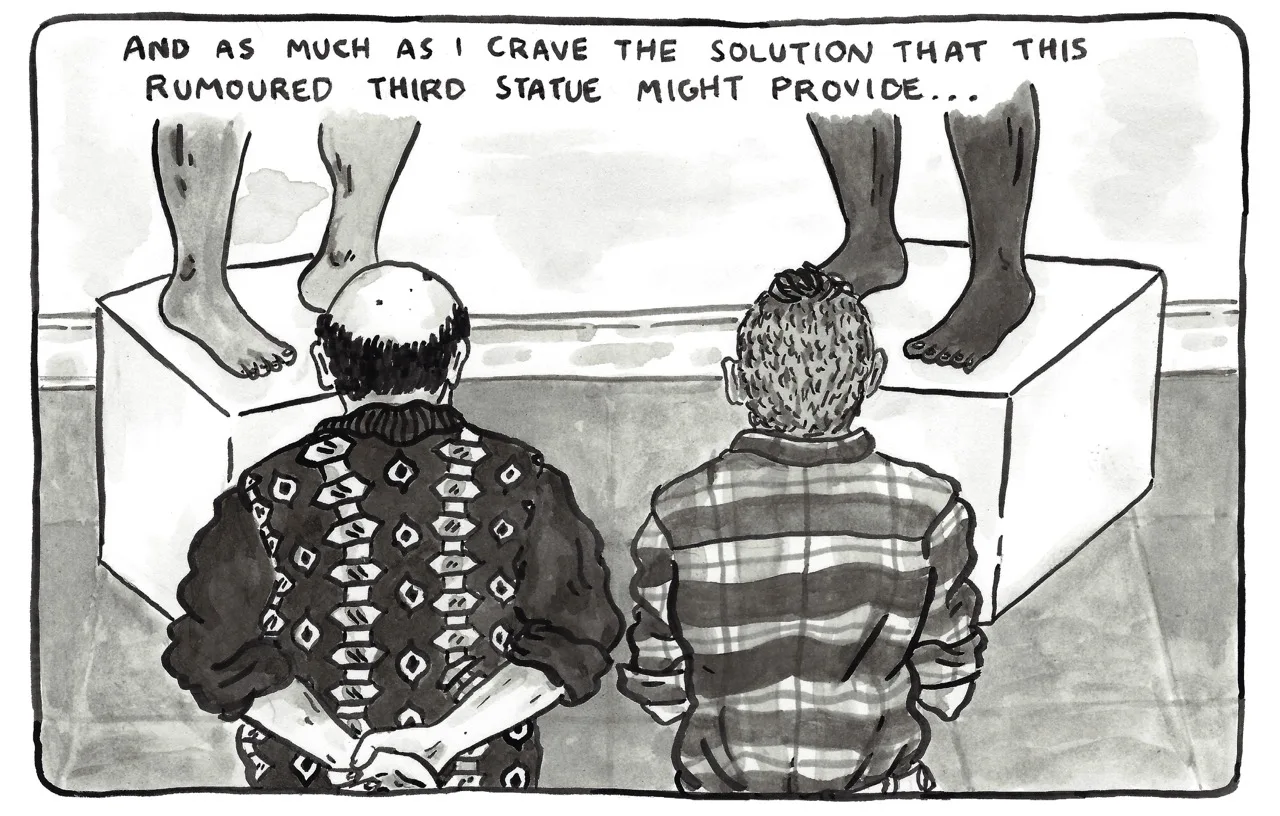
Panel 45 shows Bronze A in ¾ profile. Cesario gazes up at the Bronze, struck. His nonno stands beside him, arms crossed and smiling. The text reads “Pausanias’s record is a tantalizing potential origin story for the Bronzes…But it’s only one possibility. As with my grandfather’s name, a hunt for answers yields only more questions.”Panel 46 shows Cesario and his nonno from behind, gazing up at the Bronzes. The text reads “and as much as I crave the solution that this rumoured third statue might provide…”
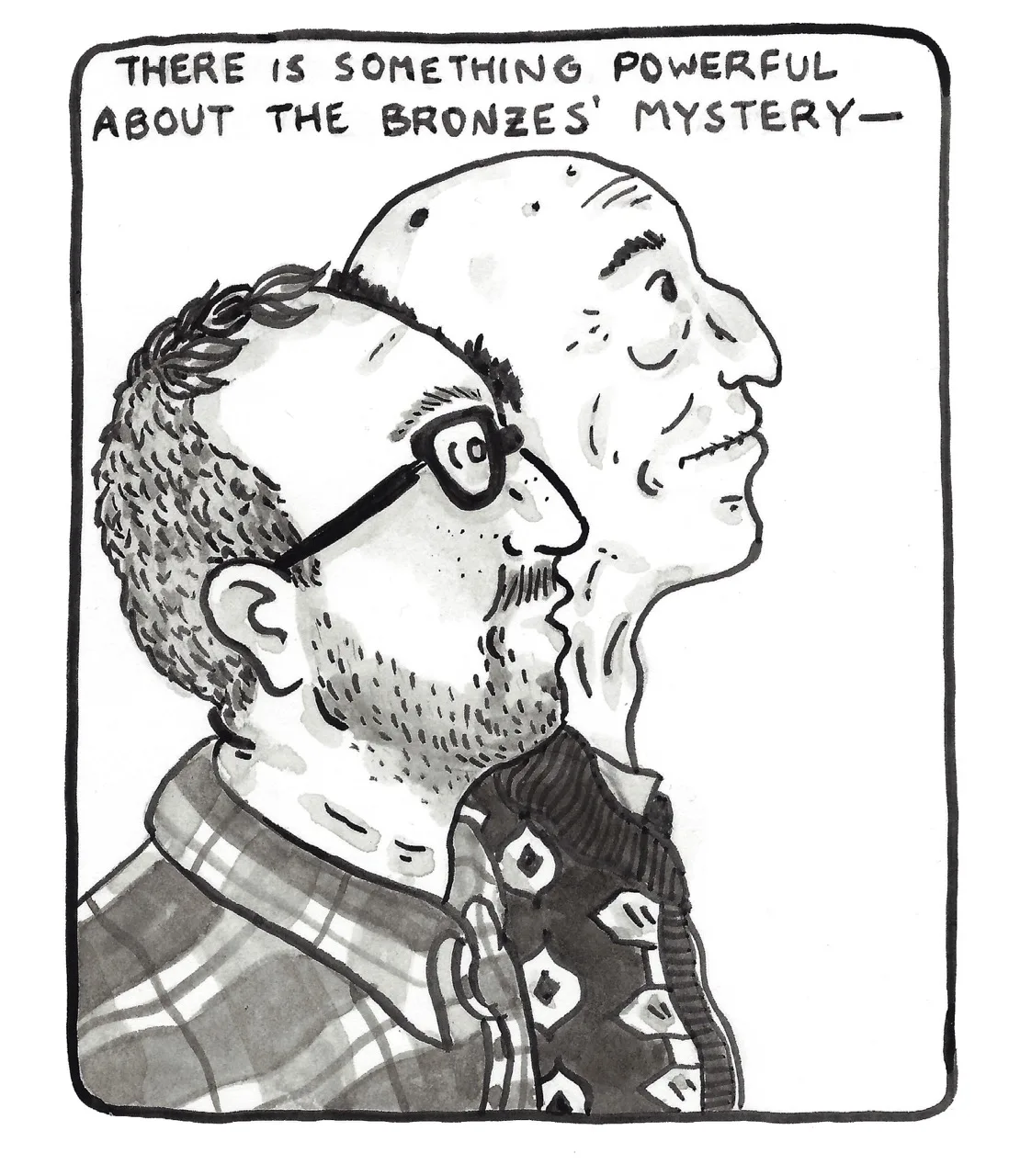
Panel 47 is of Cesario and his nonno gazing upwards, side-by-side and in profile. The caption reads “There is something powerful about the Bronzes’ mystery —”
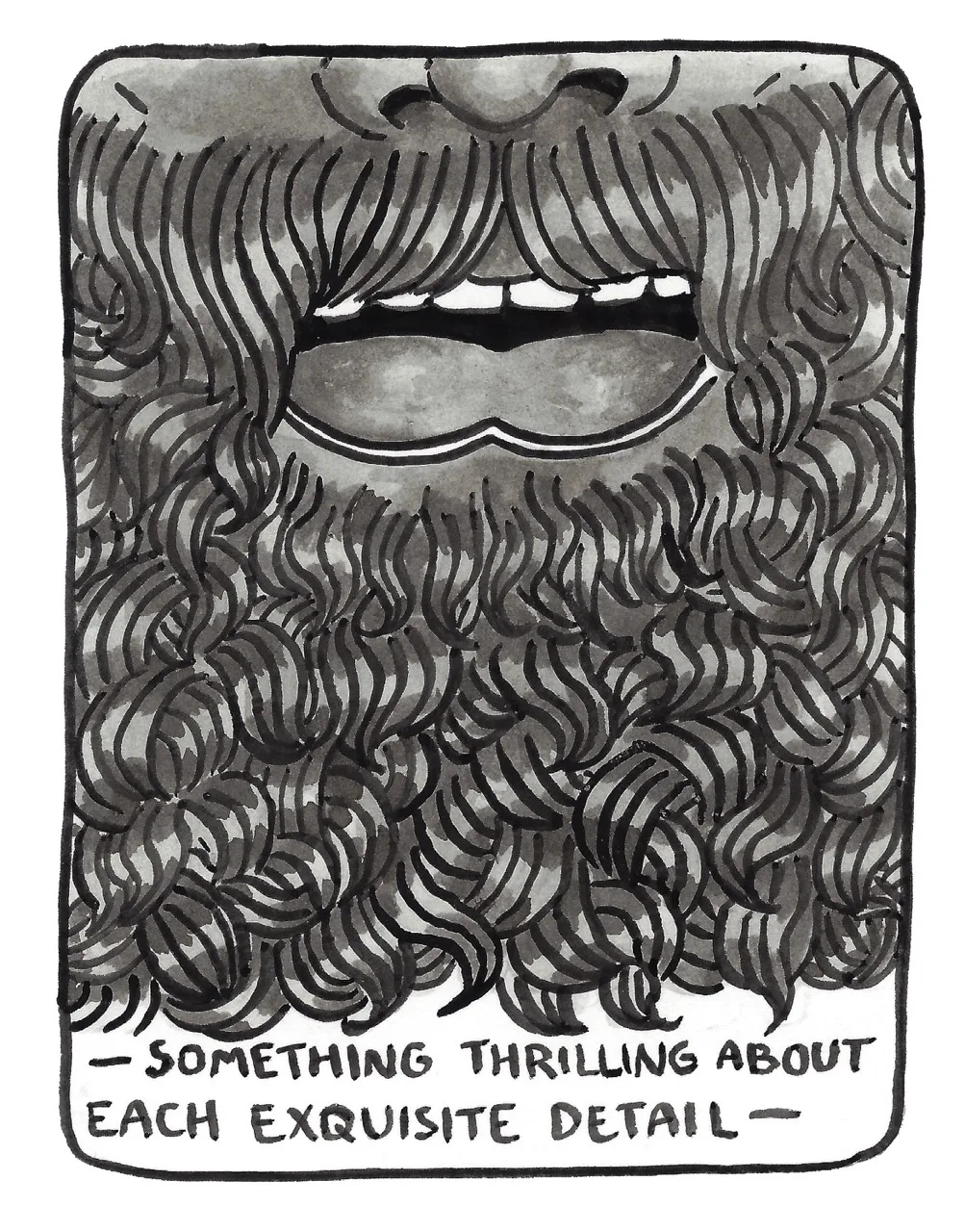
Panel 48 is a closeup of the lower half of Bronze A’s face, showing the detailed curls of his beard and his teeth behind his parted lips. The text reads “— something thrilling about each exquisite detail —”
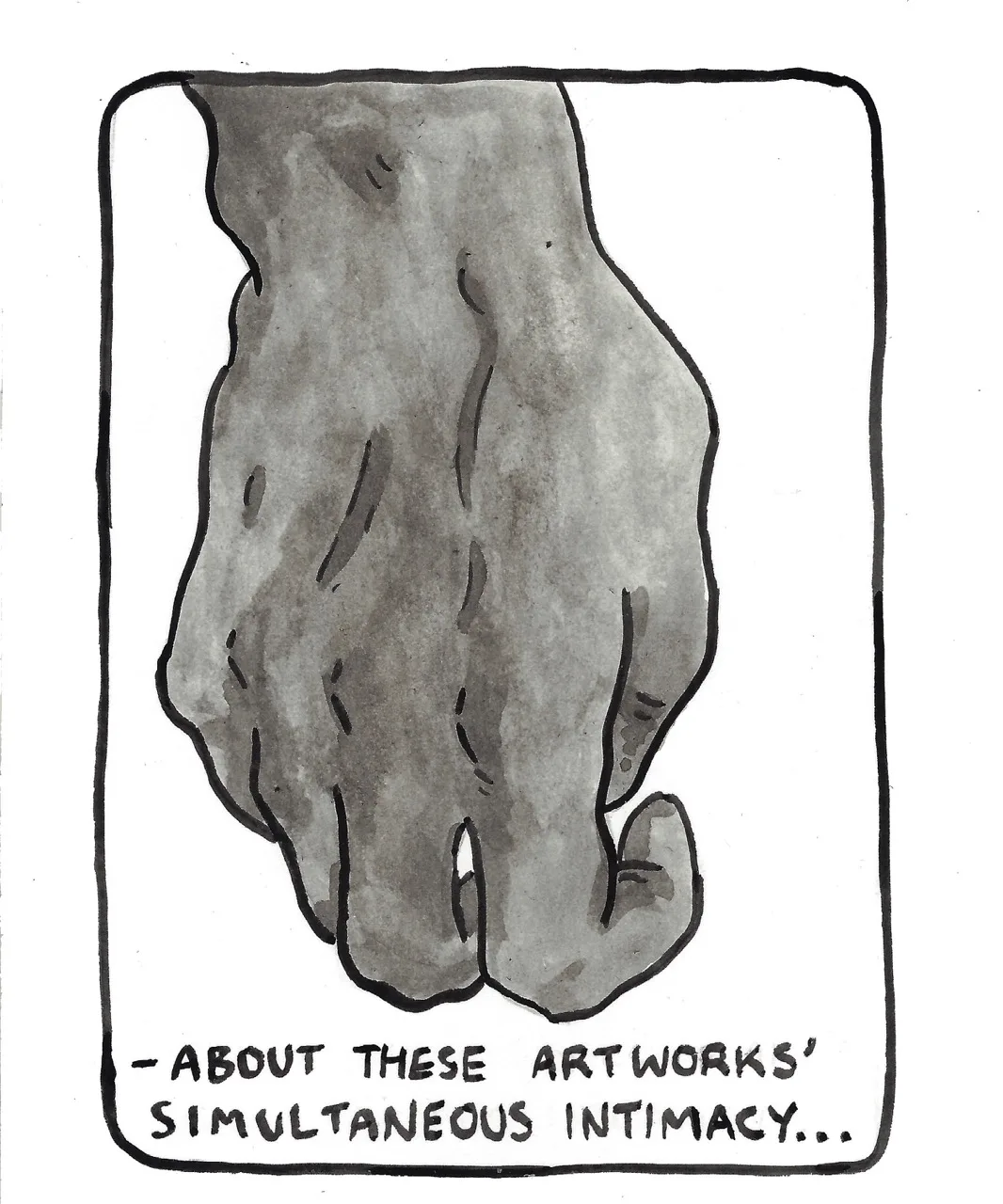
Panel 49 is a closeup of Bronze A’s hand. The text reads “—about these artworks’ simultaneous intimacy…”
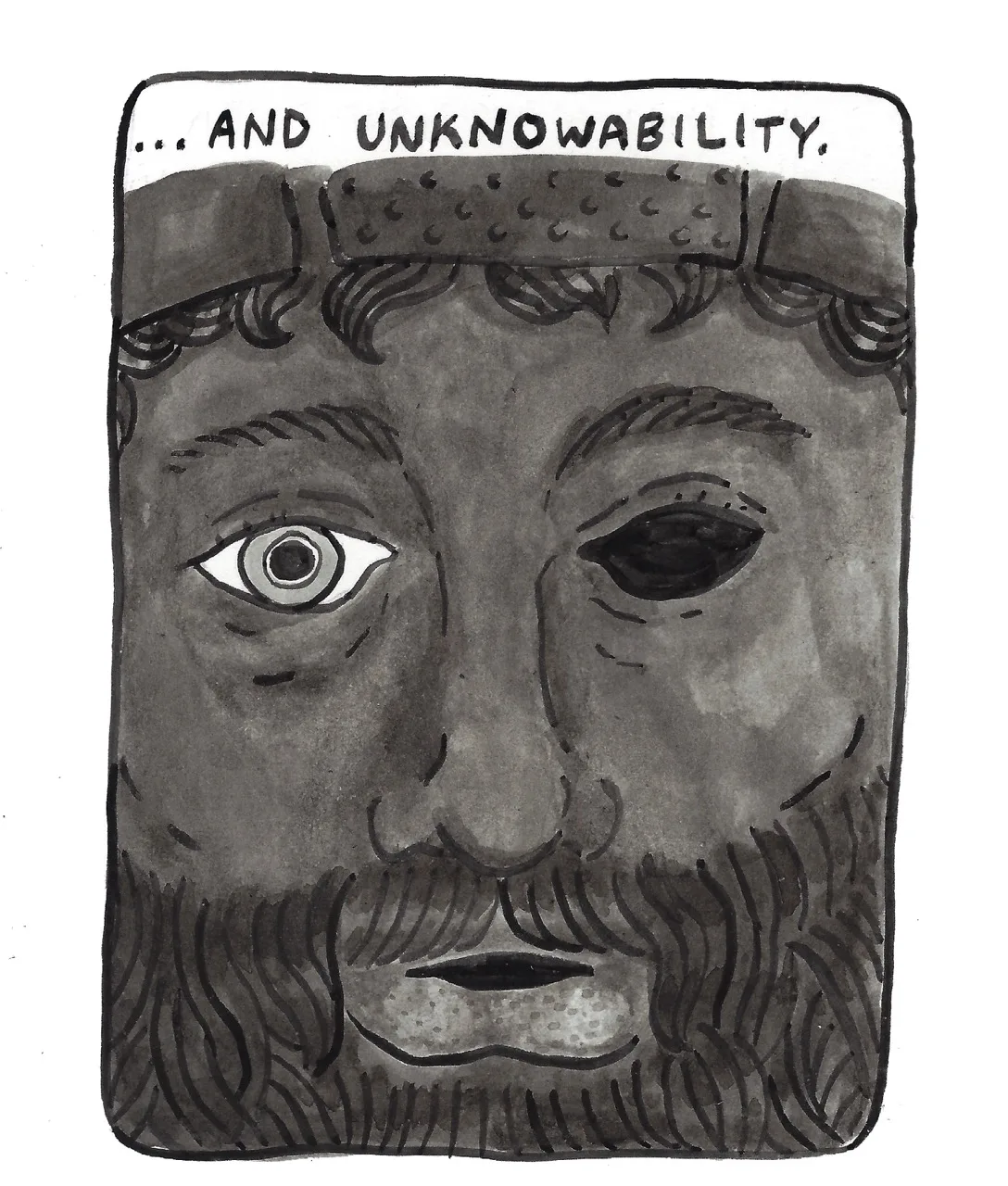
Panel 50 is a closeup of Bronze B’s face, his expression weary; one eye missing. The caption continues, “...and unknowability.”
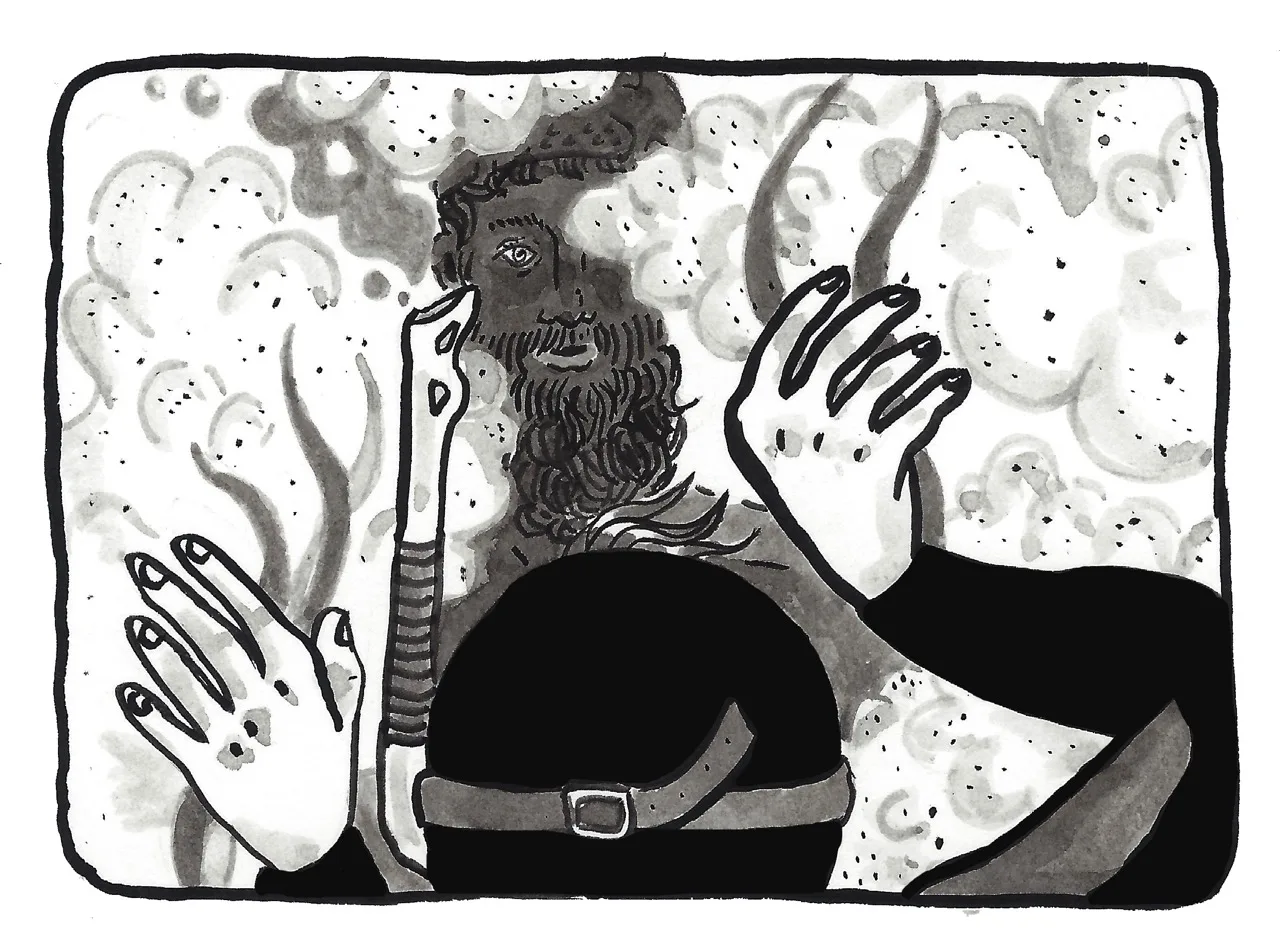
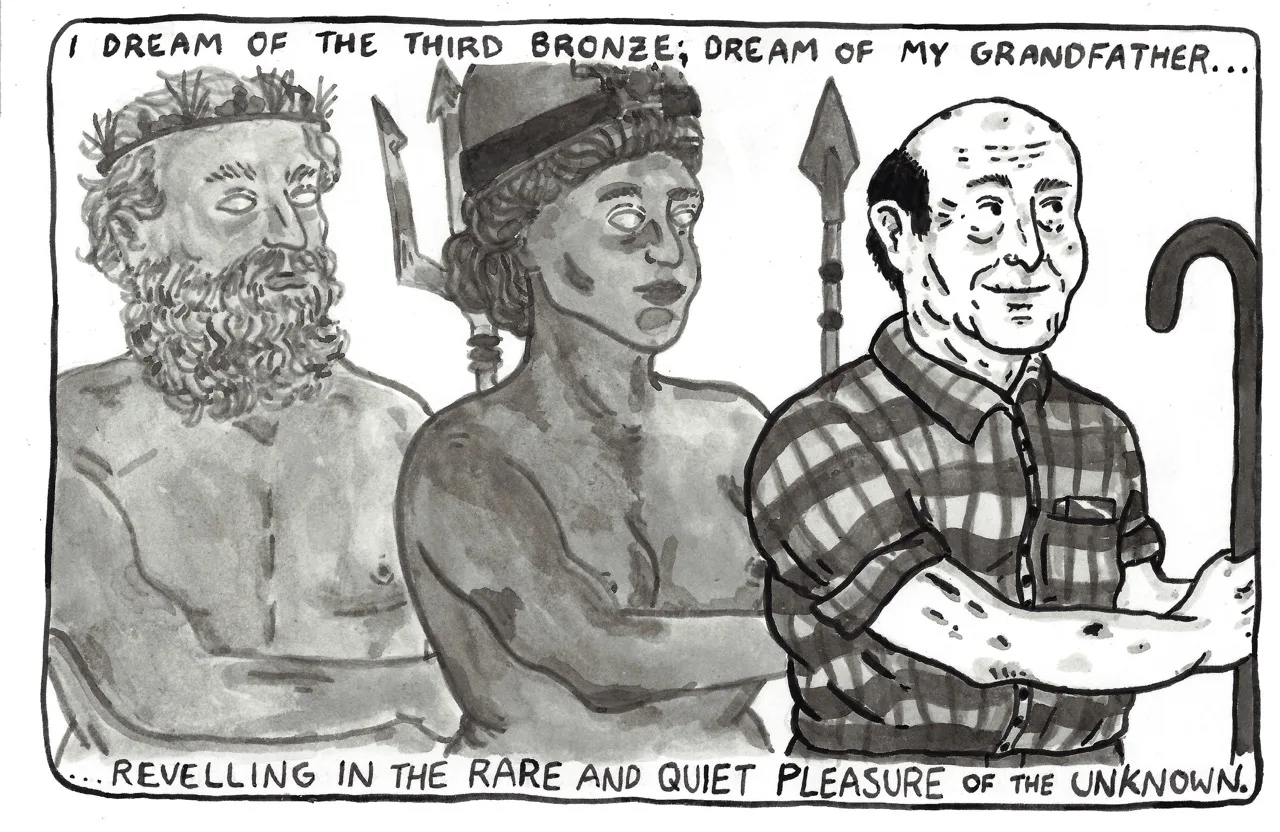
Panel 51’s text begins “I dream of the third Bronze; dream of my grandfather…”. In very light tones, there is a ghostly statue of Poseidon, wearing a crown and bearing a trident; then in front of him, slightly darker, a statue of Athena, helmeted and carrying a spear; and finally, in the clearest and darkest tones, of Cesario’s nonno, smiling slightly and holding his shepherd’s crook. The text concludes, “Revelling in the rare and quiet pleasure of the unknown.”
This comic was edited by Geetha Iyer and Sanika Phawde.

Sources

“Bronzi Di Riace: Il Giallo Dello Scudo, Dell’elmo e Del Terzo Bronzo Spariti.” Le Iene, performance by Antonino Monteleone, and Marco Occhipinti, Italia 1, 3 Oct. 2019, https://www.iene.mediaset.it/video/bronzi-riace-misteri-reperti-mare_524659.shtml. Accessed 30 Mar. 2026. 

Brooks, Andrée. “In Italian Dust, Signs Of a Past Jewish Life.” The New York Times, 15 May 2003, www.nytimes.com/2003/05/15/arts/in-italian-dust-signs-of-a-past-jewish-life.html

Dodge, Theodore Ayrault. Hannibal: A History of the Art of War among the Carthaginians and Romans Down to the Battle of Pydna, 168 B.C., with a Detailed Account of the Second Punic War. Houghton, Mifflin and Company, 1891. 

Imam, James. “Italian Mayor Launches Underwater Excavation to Find Third Riace Bronze.” The Art Newspaper, 15 Oct. 2021, www.theartnewspaper.com/2021/10/15/golden-anniversary-for-riace-bronzes-to-be-marked-in-calabrian-town-near-where-they-were-found

Lax, Gabriella. “Riace, Trifoli: «Cercare Il Terzo Bronzo? Una Provocazione. Ma La Città Non Ha Mai Avuto Nulla».” Il Reggino, 18 July 2021, www.ilreggino.it/cultura/riace-trifoli-cercare-il-terzo-bronzo-una-provocazione-ma-la-citta-non-ha-mai-avuto-nulla-v0mhb93p

Malacrino, Carmelo, et Nicolas Véron. “Découverte, Restaurations, Expositions. Histoire de Deux Chefs-d’Œuvre de l’art Mediterranéen.” Les Bronzes de Riace, 5 Continents Editions, Milan, Italy, 2022, pp. 73–88. 

Murphy, Nick. “More Human Than Human…” How Art Made the World, performance by Nigel Spivey, season 1, episode 1, British Broadcasting Corporation, 26 June 2005. 

Osborne, Robin. “The Riace Bronzes.” What Makes a Masterpiece: Artists, Writers and Curators on the World’s Greatest Works of Art, Thames & Hudson Ltd., London, England, 2010, pp. 42–45. 

Prodger, Michael. “Mystery of the Missing Bronze: A New Excavation to Find the Third Riace Statue Is Planned.” The Critic, Feb. 2022, thecritic.co.uk/issues/february-2022/mystery-of-the-missing-bronze/

Shirley, David L. “Italy Celebrates Two Greek Bronzes.” The New York Times, 10 Oct. 1982, p. 31, https://www.nytimes.com/1982/10/10/arts/italy-celebrates-two-greek-bronzes.html. Accessed 30 Mar. 2026. 

Spivey, Nigel. “The Riace Bronzes: Pheidian Works?” Greek Sculpture, Cambridge University Press, Cambridge, England, 2013, pp. 187–188. 

Von Falkenhausen, Vera. “The Jews in Byzantine Southern Italy.” Jews in Byzantium: Dialectics of Minority and Majority Culture, vol. 14, 1 Jan. 2012, p. 271–296. Jerusalem Studies in Religion and Culture, https://doi.org/10.1163/ej.9789004203556.i-1010.36

More Comics

Join our newsletter

Get Crucial Comix in your inbox!
© 2026 Crucial Comix